

When you walk into a hospital in Pakistan, the floor beneath your feet does far more than simply support your weight. It carries the silent responsibility of preventing infections, withstanding constant chemical disinfection, supporting heavy medical equipment, and maintaining a clean, professional appearance day after day. Yet, for decades, many healthcare facilities across Pakistan relied on ceramic tiles, polished cement, or basic floor paint. However, materials that develop cracks, grout lines, and porous surfaces over time, all of which can trap bacteria, moisture, and contaminants.
That is exactly why hospital epoxy flooring in Pakistan has become one of the most sought-after healthcare infrastructure investments in recent years. From government hospitals in Lahore to private medical complexes in Karachi and specialised diagnostic centres in Islamabad. Healthcare administrators are recognising that the right floor is not just an aesthetic choice — it is a patient safety decision.
This comprehensive guide covers everything you need to know about hospital epoxy flooring in Pakistan: what makes it the right choice for medical environments. Which hospital zones require specific flooring standards, what the installation process involves, how much it costs, and what to look for when choosing an installer.
What Makes Epoxy Flooring Suitable for Hospitals?
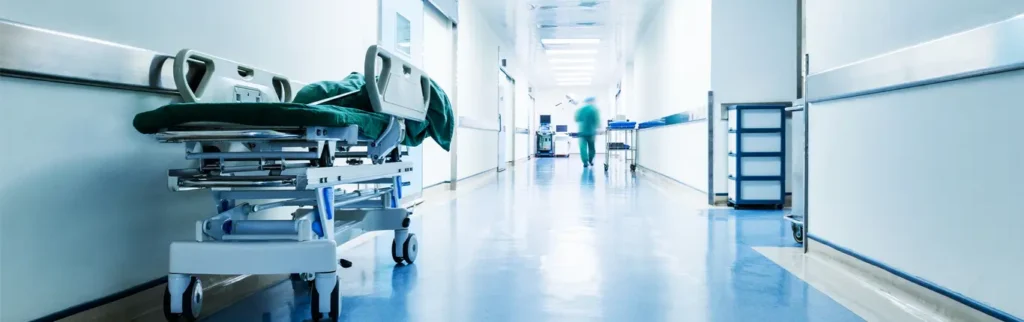
Healthcare facilities operate in a uniquely demanding environment. Unlike a factory floor or a commercial showroom, a hospital floor must meet rigorous requirements for hygiene, safety, chemical tolerance, and patient wellbeing simultaneously. Epoxy floor coating addresses each of these requirements in ways that conventional flooring simply cannot match.
1. It Creates a Genuinely Seamless Surface
One of the most critical factors in any medical environment is the absence of gaps, joints, or grout lines where microorganisms can colonise and multiply. The seamless floor coating that epoxy provides bonds directly to the concrete substrate, creating one continuous, unbroken surface across the entire floor area. There are no tile edges for moisture to seep beneath, no grout channels to trap biological matter, and no cracks for disinfectants to miss.
This seamless floor coating quality is not just a cosmetic benefit — it is a fundamental infection control feature that healthcare facilities are increasingly required to demonstrate during accreditation and inspection.
2. Anti-Bacterial Properties Built Into the Surface
A quality anti-bacterial epoxy floor is formulated with additives that actively resist microbial growth on the surface itself. Standard epoxy resins already form a non-porous barrier that denies bacteria any foothold, but medical-grade formulations go further by incorporating antimicrobial compounds into the resin layer. The result is an anti-bacterial epoxy floor that not only prevents bacteria from hiding in crevices but also reduces surface colony counts between cleaning cycles.
In Pakistan’s healthcare sector, where hospital-acquired infections (HAIs) remain a significant concern, this feature alone makes epoxy flooring a compelling investment for hospital management.
3. Non-Porous and Dust-Free by Nature
A non-porous floor surface does not absorb liquids, chemicals, or airborne particles. This means blood, saline, disinfectant agents, pharmaceutical spills, and even radioactive contrast dyes used in imaging departments cannot penetrate the flooring layer. The non-porous floor surface can be wiped, mopped, or jet-cleaned repeatedly without degrading the material underneath.
The dust-free floor surface characteristic of epoxy is equally important. In surgical and intensive care areas, airborne particles settling on the floor can be resuspended with foot traffic, contributing to contamination. A dust-free floor surface achieved through epoxy’s dense, smooth finish significantly reduces particulate movement within sensitive zones.
4. Chemical Resistance That Supports Aggressive Cleaning Protocols
Hospitals use some of the most aggressive cleaning agents available — concentrated bleach solutions, phenolic disinfectants, iodine-based agents, glutaraldehyde, and hydrogen peroxide vapour. Most conventional flooring degrades under repeated exposure to these substances. Epoxy resin flooring, by contrast, is engineered specifically for chemical-resistant flooring performance in industrial and clinical settings.
The chemical-resistant flooring capability of medical-grade epoxy means that cleaning teams can apply full-strength disinfectants as frequently as required without worrying about floor surface degradation, staining, or delamination. This ensures both a safer patient environment and a lower long-term replacement cost.
5. Slip Resistance That Protects Patients and Staff
Hospital floors get wet many times throughout a day — from mopping, spills, patient care activities, and equipment cleaning. A slip on a wet floor represents a serious safety risk for elderly patients, post-operative individuals, and staff carrying equipment. Slip-resistant epoxy floor finishes incorporate fine aggregate textures or anti-slip broadcast media into the surface layer, increasing traction even when wet.
This slip-resistant epoxy floor quality is particularly important in corridors, bathrooms, shower rooms, and areas adjacent to operating theaters where floors are cleaned most frequently.
Hospital Zones and Their Specific Epoxy Flooring Requirements
Not every area in a hospital has identical flooring requirements. A waiting lounge, an operation theater, an ICU ward, and a pharmacy each present different levels of foot traffic, contamination risk, and technical demand. Understanding these differences helps hospital planners specify the correct epoxy flooring system for each zone.
Operation Theater Flooring
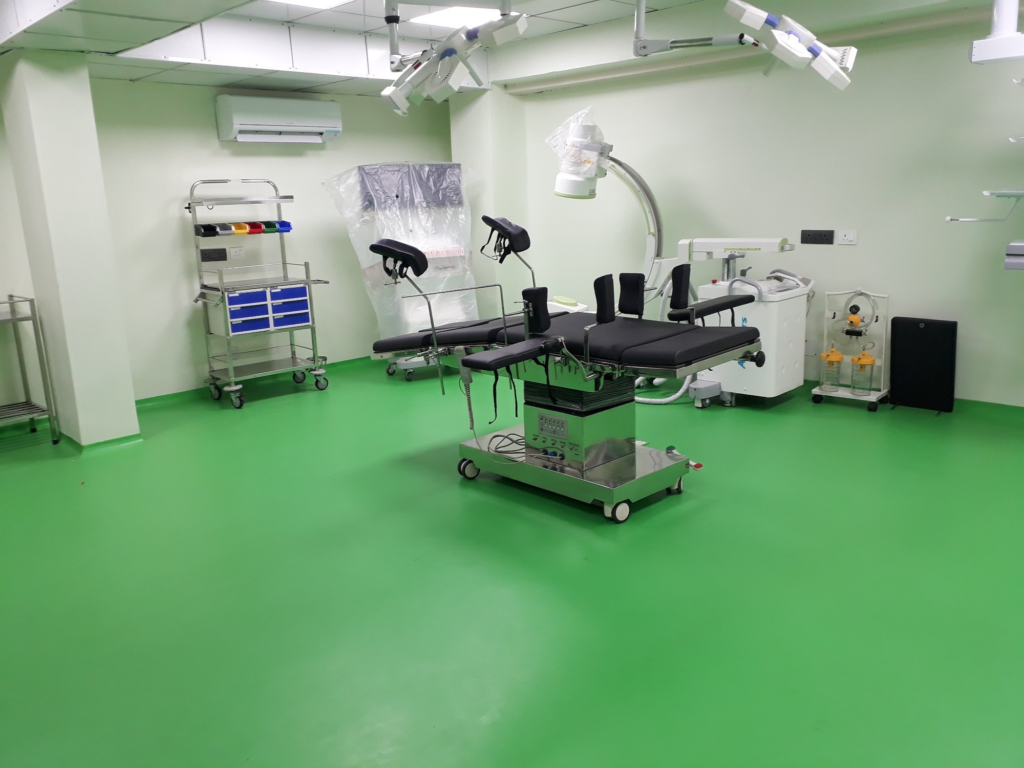
The operation theater is arguably the most demanding environment in any hospital. It requires a sterile environment flooring solution that can withstand continuous disinfection, support heavy surgical tables and equipment, resist cuts and impact from dropped instruments, and crucially — prevent the build-up of static electricity that could interfere with sensitive electronic monitoring equipment.
Operation theater flooring achieved through anti-static epoxy flooring systems is the standard of practice in well-equipped Pakistani hospitals. Anti-static epoxy flooring is specifically formulated to dissipate electrostatic charges safely, protecting both electronic equipment and patients. The floor surface for clean rooms in OT settings must also meet strict particle count standards, and epoxy’s seamless, dust-free characteristics make it fully compatible with these requirements.
Recommended system: Conductive or dissipative epoxy, 3–4mm thickness, with anti-static topcoat.
ICU Floor Surface Requirements
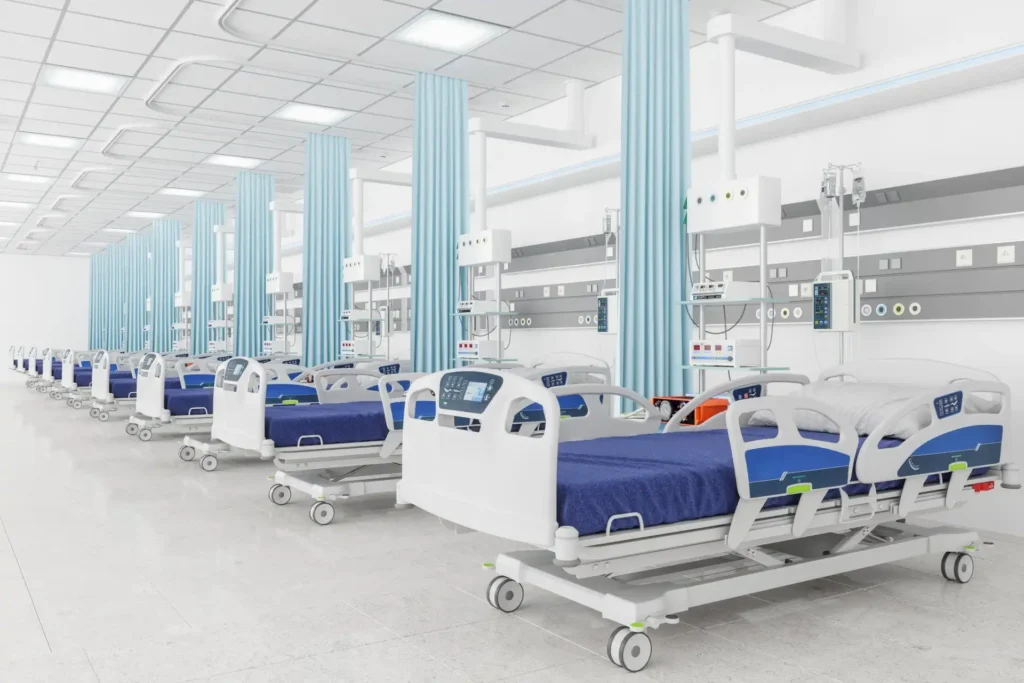
The ICU floor surface carries a uniquely complex set of demands. Patients in intensive care are extremely vulnerable to infection, so hygienic flooring for hospitals in this zone must be at its most rigorous. At the same time, heavy rolling equipment — ventilators, ECMO machines, medication trolleys — moves across the ICU floor surface constantly, requiring outstanding mechanical strength and abrasion resistance.
A properly specified ICU floor surface uses a self-leveling epoxy system at 3mm minimum thickness, with an anti-bacterial topcoat. A light anti-slip texture that does not impede wheeled equipment but prevents slipping by staff in clinical footwear.
Ward and Corridor Flooring (Hospital Ward Flooring)

Hospital ward flooring faces the highest foot traffic volumes of any clinical zone. Visitors, nursing staff, cleaning crews, and patient transport all converge in corridors and general wards throughout a 24-hour cycle. Durable hospital floor systems for these areas must resist scuffing, scratching, and staining while remaining easy to clean and visually clean-looking over time.
The recommended system for hospital ward flooring is a medium-build self-leveling epoxy at 2–3mm, available in light, reflective colours that enhance ambient lighting and reduce energy consumption in facilities where artificial lighting is a significant operating cost. Healthcare-grade floor finish in these zones should also be rated for compatibility with floor-scrubbing machines used in large facilities.
A healthcare-grade floor finish in corridors and wards should ideally be specified in muted, professionally appropriate colours — pale grey, off-white, or light beige. That maintain a clinical appearance and allow visible cleanliness confirmation at all times.
Pharmacy Flooring Pakistan
Pharmacy flooring Pakistan requires a different balance of properties compared to surgical zones. In a hospital pharmacy, the primary concerns are chemical resistance (to pharmaceutical compounds and cleaning agents), anti-static performance (to protect electronic dispensing systems), and cleanability. Pharmacy flooring Pakistan should be smooth enough for easy mopping but not so polished that it creates dangerous glare under pharmacy lighting.
A thin-build epoxy coating of 1.5–2mm with an anti-static topcoat performs excellently as pharmacy flooring in Pakistan’s hospital environments, both in institutional pharmacies and outpatient dispensing counters.
Diagnostic Center Flooring
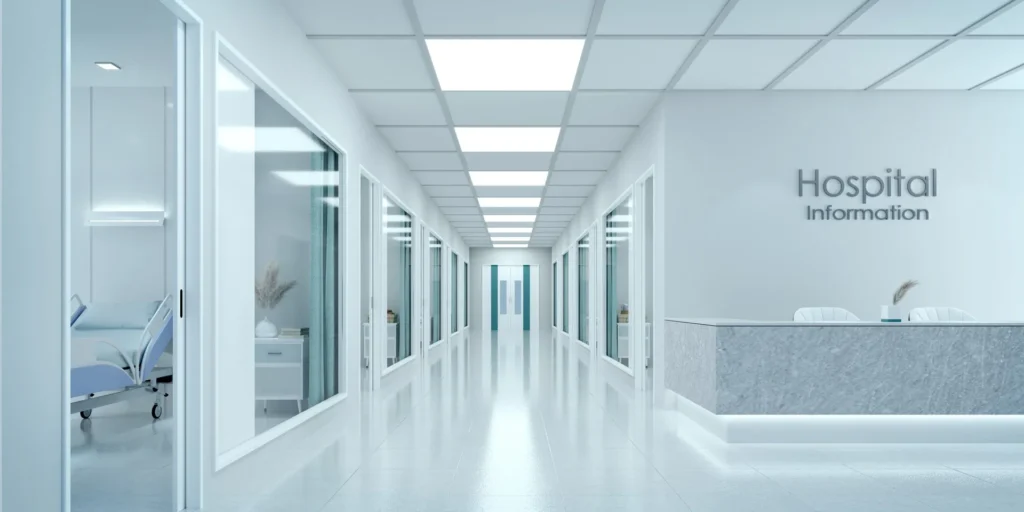
Diagnostic center flooring presents a unique combination of requirements. In radiology suites, the floor must be compatible with lead shielding requirements. Moreover, In pathology laboratories, the diagnostic center flooring must resist biological spills and chemical reagents. In phlebotomy rooms and sampling areas, it must be easy to sanitise rapidly between patients.
Epoxy floor coating systems with a mid-build thickness and specialist chemical-resistant flooring topcoat are widely used in diagnostic center flooring across Pakistan’s growing private diagnostics sector. The non-porous nature of epoxy ensures that biological waste cannot penetrate the substrate even in the event of major spills.
Epoxy Flooring Systems Used in Pakistani Hospitals
The term “epoxy flooring” covers a family of related systems, and choosing the correct one for each hospital zone is critical to long-term performance. Here is an overview of the systems most commonly specified for healthcare flooring Pakistan:
Self-Leveling Epoxy Systems
Self-leveling epoxy is the most widely used system for large clinical areas such as wards, corridors, and diagnostic spaces. The liquid resin mixture flows naturally across the prepared concrete substrate and levels itself before curing. Producing a uniformly smooth surface without visible application marks. Self-leveling epoxy creates the ideal seamless floor coating for clinical environments. Because it leaves no ridges, brush marks, or application inconsistencies that could harbour contamination.
In Pakistan, self-leveling epoxy systems suitable for healthcare use are available from reputable suppliers and are applied at thicknesses between 2mm and 4mm depending on zone classification. The curing process typically requires 24 to 48 hours before light foot traffic. It is permitted and 72 hours before heavy equipment can be moved across the surface.
Epoxy Resin Flooring with Anti-Microbial Topcoat
Standard epoxy resin flooring can be upgraded for medical use through the addition of a specialist anti-microbial topcoat applied as a final layer. This system uses the mechanical and chemical properties of the standard epoxy resin flooring base. While adding active infection control properties at the surface where they matter most. This approach is cost-effective because it avoids the expense of fully medical-grade epoxy throughout the entire build-up. While still achieving infection control flooring certification where required.
Infection control flooring certified systems are particularly important for Pakistani healthcare facilities seeking international accreditation. A growing priority among private hospital groups in Lahore, Karachi, and Islamabad.
Anti-Static Epoxy for OT and ICU
As noted in the zone-specific section, floor coating for medical facilities that house sensitive electronic equipment. It requires a specifically formulated anti-static epoxy. This floor coating for medical facilities is available in both conductive (very low resistance, for extremely sensitive environments) and dissipative (moderate resistance, for standard OT and ICU applications) variants.
Proper specification requires an electrical resistance test after installation to confirm compliance with the relevant safety standards. Reputable contractors offering hospital epoxy flooring in Pakistan will conduct and document this testing as part of their handover process.
How Hospital Epoxy Flooring Is Installed in Pakistan
The installation process for healthcare flooring Pakistan is more rigorous than standard commercial or residential epoxy applications. Every step must be carried out with precision because any defect. A bubble, a contaminated substrate, an uneven primer coat. It will compromise both the performance and the hygiene characteristics of the finished floor.
Step 1: Surface Assessment and Preparation
Before any material is applied, the existing concrete substrate undergoes a thorough condition assessment. The contractor checks moisture levels (epoxy will not bond to damp concrete), identifies cracks or hollow areas. It tests the surface for contamination from oil or chemical residues, and confirms the flatness tolerance. In operational hospital areas, this assessment phase also involves planning work schedules to minimise disruption to clinical activities.
Surface preparation typically involves mechanical grinding or shot blasting to open the concrete pores and create a profile suitable for epoxy adhesion. Cracks are filled with compatible epoxy mortar. This preparation stage is arguably the most important single factor in the long-term durability of the finished floor.
Step 2: Primer Application
An epoxy primer is applied to the prepared substrate to penetrate the concrete pores, consolidate the surface, and create a chemical bond layer for the main coating. In hospital applications, a low-viscosity primer that can penetrate deeply into the concrete matrix is preferred over surface-only primers.
The primer must cure for the manufacturer’s specified time — typically 8 to 16 hours — before the main coating layer is applied. Rushing this step is one of the most common causes of delamination failure in epoxy floors across Pakistan.
Step 3: Main Epoxy Coat Application
The main epoxy floor coating layer is mixed on-site from the two-component resin and hardener in the exact ratios specified by the manufacturer. Any deviation in the mixing ratio compromises the chemical reaction and results in a floor that never fully cures. In medical environments, this step is typically performed by experienced installers rather than general labour.
For self-leveling epoxy systems, the mixed material is poured and spread using a spiked roller to release any trapped air before the material begins to set. For zones requiring broadcast aggregate for anti-slip performance, dry silica aggregate is scattered across the wet surface immediately after pouring.
Step 4: Topcoat and Sealer
The topcoat layer provides the final visual finish, the anti-bacterial or anti-static properties. The chemical-resistant flooring performance of the completed system. In hospital applications, the topcoat is also typically formulated for compatibility with the UV disinfection lamps. It commonly used in Pakistani operating theaters and ICU environments.
Step 5: Curing, Testing, and Handover
After the topcoat is applied, the floor requires a full cure period before clinical use. In Pakistan’s climate, cure times vary with ambient temperature. However. warmer conditions accelerate curing while winter installation in cities like Islamabad may extend cure times significantly. A responsible contractor will confirm surface hardness, adhesion, and (where applicable) electrical resistance before handing the floor over to the hospital team.
Epoxy Flooring Cost Pakistan — Hospital Sector Pricing
Epoxy flooring cost Pakistan varies considerably based on the system specified, the zone requirements. The condition of the existing substrate, and the geographic location of the facility. The following cost ranges represent approximate 2026 market pricing for hospital-grade epoxy flooring installation in Pakistan:
| Zone / System | Approximate Cost (PKR per sq ft) |
|---|---|
| General ward — standard epoxy (2mm) | PKR 350–550 |
| Corridor — self-leveling epoxy (2.5mm) | PKR 400–600 |
| ICU — anti-bacterial system (3mm) | PKR 600–900 |
| OT — anti-static conductive system (3–4mm) | PKR 900–1,500 |
| Pharmacy — anti-static thin-build | PKR 500–750 |
| Diagnostic lab — chemical-resistant system | PKR 600–950 |
| Basement / utility areas | PKR 280–450 |
These epoxy flooring cost Pakistan figures are indicative. Final costs depend on surface condition (heavily damaged concrete increases preparation costs), floor area (larger projects attract lower per-sq-ft rates). Its specification of branded vs generic resins, and contractor overhead in different cities.
As a general orientation, epoxy flooring cost Pakistan for a 10,000 sq ft hospital ward floor. It will typically fall in the range of PKR 4.5 million to PKR 7 million for a fully certified, healthcare-grade installation. However, a figure that compares favourably with the lifecycle cost of tile replacement, maintenance, and infection risk associated with grouted surfaces.
Why Pakistani Hospitals Are Moving Away From Tiles?
The comparison between epoxy and ceramic tiles is one that hospital administrators across Pakistan increasingly decide in epoxy’s favour. Here is why the shift is happening:
Tiles are installed with grout, and grout is porous. No matter how rigorously cleaning staff scrub grout lines, microbial colonisation within the grout matrix is extremely difficult to eliminate. Studies have consistently shown that grout lines remain reservoirs of contamination even after surface cleaning. In an environment where infection control is a clinical priority, this is not an acceptable trade-off.
Beyond hygiene, tiles crack under the point loads exerted by heavy medical equipment — particularly beds with castors, imaging machines, and trolleys carrying cylinders. Each cracked tile becomes a contamination risk and a trip hazard. The repair process requires removing and replacing individual tiles, creating significant disruption in occupied clinical areas.
Epoxy’s seamless, monolithic surface eliminates both concerns. There are no grout lines, no individual tile edges to crack, and no replacement process that requires clinical area closure. When damage does occur — typically from extreme impact — epoxy can be locally repaired without disrupting the surrounding floor area.
Choosing the Right Epoxy Flooring Contractor for a Hospital in Pakistan
Selecting a contractor for epoxy floor installation in a hospital setting requires more care than a standard commercial project. The consequences of a poor installation — premature delamination, inadequate anti-bacterial performance, failure to meet anti-static specifications — are not merely aesthetic. They represent genuine patient safety risks.
Key criteria to evaluate include documented experience with hospital and clinical projects, knowledge of zone-specific technical specifications, ability to provide and interpret material technical data sheets. Capacity to conduct post-installation testing (especially electrical resistance testing for OT and ICU areas). Moreover, a clear methodology for working in occupied or partially occupied hospital environments.
Epoxy floor installation Pakistan for hospitals should always be carried out with a written specification document. A clearly defined scope of work, and a performance warranty from the contractor covering both material defects and application quality.
Maintenance of Hospital Epoxy Floors in Pakistan
One of the most significant operational advantages of healthcare flooring Pakistan using epoxy is the simplicity of the maintenance protocol. Unlike tiles, which require periodic grout re-sealing, or polished concrete, which requires periodic re-polishing. However, a properly installed epoxy floor in a hospital needs only routine wet mopping with a compatible disinfectant to maintain both hygiene and appearance.
The key maintenance rules for durable hospital floor longevity are straightforward. Use only pH-neutral or manufacturer-approved cleaning agents — highly alkaline or strongly acidic cleaners should be verified as compatible before use. Avoid dragging sharp-edged metal objects across the floor surface. Inspect the floor surface periodically for any surface scratches or impact damage that could provide initiation points for coating failure. Address any damage immediately with a compatible repair kit rather than allowing a minor defect to propagate.
With this level of care, a properly installed hospital epoxy floor in Pakistan should deliver a service life of 10 to 15 years before a full recoat is required. Making it one of the most cost-effective flooring investments available to Pakistani healthcare facility managers.
Conclusion
Hospital epoxy flooring in Pakistan has evolved from a niche industrial product into an essential healthcare infrastructure standard. As Pakistan’s healthcare sector continues to expand — with new private hospital complexes, government health city projects, and specialist diagnostic facilities opening across the country. The specification of appropriate clinical flooring is moving from an afterthought to a front-of-mind design priority.
The combination of seamless construction, anti-bacterial surface properties, chemical-resistant flooring performance, anti-static capabilities where required. A realistic 10 to 15 year service life makes epoxy the most technically credible flooring choice for every zone of a modern Pakistani hospital. Moreover, paired with competitive epoxy flooring cost Pakistan pricing that has become increasingly accessible as the local installation market matures. The case for epoxy over tiles or conventional paints in healthcare settings is now effectively beyond debate.
If you are planning a hospital flooring project in Pakistan — whether a new build, a renovation, or a zone-specific upgrade. Unicorn Flooring offers site assessments, technical specifications, and certified installation across Lahore, Karachi, Islamabad, Faisalabad, and beyond.
FAQ’S
Is epoxy flooring safe for patients in Pakistan’s hospitals?
Yes. Medical-grade epoxy formulations used in hospital environments are non-toxic once fully cured and have no off-gassing or odour in the cured state. During installation, the clinical area should be vacated and properly ventilated as the uncured resin has a characteristic chemical odour. Once the cure is complete — typically 72 hours after topcoat application — the floor is fully safe for clinical occupancy.
Can epoxy flooring be installed on existing tiles in a hospital?
In some cases, yes — epoxy can be applied over firmly bonded, flat ceramic tile with appropriate surface preparation and a bonding primer. However, in hospital settings this approach carries risk, as any subsurface void beneath existing tiles can cause the epoxy layer to delaminate over time. Most reputable contractors recommend full tile removal for critical clinical zones.Properly specified and installed epoxy flooring systems are fully compatible with the hygiene and safety standards required by Pakistan’s accreditation bodies, including JCIA-equivalent standards being adopted by major private hospital networks. Ensure your contractor provides documentation of the product specifications and post-installation test results for your accreditation file.
How long does hospital epoxy floor installation take?
A typical ward or corridor area of 1,000 sq ft requires approximately 3 to 5 working days including surface preparation, priming, main coat application, topcoat, and initial cure. Larger areas or more complex specifications (such as anti-static OT floors) may take longer. Work can often be phased to minimise disruption to adjacent clinical activities.
Does epoxy flooring meet Pakistan’s hospital accreditation requirements?
A typical ward or corridor area of 1,000 sq ft requires approximately 3 to 5 working days including surface preparation, priming, main coat application, topcoat, and initial cure. Larger areas or more complex specifications (such as anti-static OT floors) may take longer. Work can often be phased to minimise disruption to adjacent clinical activities.
What colours are available for hospital epoxy floors in Pakistan?
Medical-grade epoxy is available in a wide range of RAL and custom colours. Hospitals typically specify light greys, off-whites, and muted blues or greens for wards and corridors to maintain a clinical, calming aesthetic. OT floors are often specified in light grey or green, while diagnostic areas may use white or cream finishes to facilitate visual cleanliness checking.