

Restaurant Epoxy Flooring: The Floor Beneath the Food — Why It Matters More Than You Think

Pakistan’s restaurant industry has undergone a quiet transformation over the past decade. From the family dhabas of Lahore’s Food Street to the multi-storey fast casual chains reshaping Karachi’s commercial strips, and the upscale dining concepts emerging in Islamabad’s F-sectors and DHA developments, one consistent evolution has accompanied every level of the sector: the floor is no longer an afterthought.
Restaurant owners and F&B investors across the country are discovering what their counterparts in international hospitality markets learned years ago — the floor in a food-service environment is not simply a surface to walk on. It is a hygiene control measure, a safety system, a first impression for health inspectors, and an element of brand design that communicates quality to every guest who walks through the door.
Restaurant epoxy flooring in Pakistan has become the answer to all four of these demands simultaneously. It delivers the food-safety performance that commercial kitchens require, the slip resistance that protects kitchen staff during rush service hours, the cleanability that keeps health inspection scores high, and the aesthetic versatility that allows dining areas to express a restaurant’s identity — from a clean, minimal fast-food look to a dramatic metallic-finish fine dining statement.
This guide covers everything a restaurant owner, F&B investor, or hospitality operator in Pakistan needs to know about epoxy flooring: why it was designed for food-service environments, which zones need which specifications, how the installation works, what it costs in 2026, and how to choose the right contractor.
Why Restaurants Are a Uniquely Demanding Flooring Environment
Before exploring what epoxy offers, it is worth understanding specifically why restaurant environments are so difficult for conventional flooring materials. Most restaurateurs who switch to epoxy do so after painful experience with tile, painted concrete, or vinyl that failed to meet the operational reality of a busy food-service operation.
The Grease Problem
A commercial kitchen generates grease constantly — from fryers, griddles, cooking pots, and the simple condensation of cooking fats in the air. This grease settles on every horizontal surface including the floor. On a tiled floor with grout lines, grease penetrates the porous grout immediately and becomes nearly impossible to remove without aggressive chemical scrubbing. Over time, grease-impregnated grout becomes a bacterial reservoir and a cleaning team’s constant nightmare. On painted concrete, grease penetrates micro-pores in the paint and causes it to delaminate progressively from the substrate.
A grease-resistant floor coating in the form of correctly specified epoxy creates a fully non-porous surface that grease cannot penetrate. It sits on top of the epoxy surface, where it can be removed with standard mop-and-clean operations using hot water and a compatible degreaser. The grease-resistant floor coating characteristic of epoxy is not merely a convenience feature — in a commercial kitchen environment, it is a fundamental food hygiene requirement.
The Slip Hazard Problem
Kitchen floors in Pakistani restaurants get wet continuously. Between spills, frequent mopping, and the condensation generated by cooking equipment, a commercial kitchen floor is rarely completely dry during service hours. On a smooth tiled or painted floor, this creates a slip hazard that kitchen staff face every single working hour. Slips in commercial kitchens are among the most common workplace injury events in the food service sector — and in an environment where staff are carrying hot food, sharp knives, or fragile crockery, the consequences can be severe.
A slip-resistant restaurant floor achieved through epoxy with an appropriate aggregate texture provides reliable grip even when the floor surface is wet and contaminated with cooking residue. The slip-resistant restaurant floor quality does not require an aggressive, deep-profile texture that would trap food particles and impede cleaning — it achieves grip through fine-aggregate broadcast media or textured topcoat finishes that are simultaneously safe and hygienic.
The Health Inspection Problem
Pakistan’s food safety regulatory environment is tightening. Municipalities in Lahore, Karachi, and Islamabad have all strengthened their commercial kitchen inspection regimes. The growing number of international F&B brands operating in Pakistan brings international food safety audit standards into the local market. A hygienic floor for restaurants is not merely preferable from an operational standpoint. It is becoming a compliance requirement that restaurant owners cannot afford to fail.
Health inspectors specifically look for cracked tiles, damaged grout, exposed concrete. Flooring that cannot be cleaned to a satisfactory standard, and gaps at wall-floor junctions. Where food debris and moisture accumulate. A properly installed commercial kitchen epoxy floor — seamless, non-porous, cleanable to clinical standards, with a coved skirting at wall junctions. It satisfies every one of these inspection criteria decisively.
The Aesthetic Competitiveness Problem
In Pakistan’s increasingly competitive dining-out market, the physical environment of a restaurant is a direct contributor to customer acquisition and retention. A restaurant floor that looks clean, modern, and deliberately designed communicates professionalism and care to customers in a way that cracked tiles or faded paint emphatically cannot. Decorative epoxy for dining areas has opened up design possibilities that were simply unavailable to Pakistani restaurant owners a decade ago — seamless coloured surfaces, metallic finishes that photograph beautifully for social media, branded colour schemes, and bespoke graphic elements integrated directly into the floor surface.
Zone-by-Zone Guide: Epoxy Flooring Specifications for Every Area of a Pakistani Restaurant
A restaurant is not a single-use space. The kitchen, the dining area, the service corridor, the cold room, and the customer washrooms each present different combinations of foot traffic, liquid exposure, hygiene requirements, and aesthetic expectations. Specifying the right system for each zone is essential to both performance and cost efficiency.
The Commercial Kitchen — The Most Critical Zone
The commercial kitchen epoxy floor is the specification that demands the most technical rigour. In this zone, every performance claim matters: grease resistance, slip resistance, chemical resistance to cleaning agents, thermal resistance to hot liquid spills, and structural resistance to the point loads of heavy catering equipment.
The recommended system for a commercial kitchen epoxy floor in a Pakistani restaurant is a broadcast aggregate self-leveling epoxy at 3–4mm with a coving detail at all wall-floor junctions. Self-leveling epoxy in this application creates the seamless floor for commercial kitchen environments that Pakistani health inspectors and international food safety auditors look for — no grout lines, no exposed concrete, no gaps at skirting junctions. The broadcast aggregate provides the anti-slip texture profile required for a slip-resistant restaurant floor without compromising cleanability.
The chemical-resistant kitchen floor performance of the epoxy topcoat must specifically account for the cleaning chemicals used in that kitchen — most Pakistani commercial kitchens rely on caustic-based degreasers and bleach-based sanitisers that, applied at full concentration on a daily basis, will degrade inadequately specified floor surfaces over time. A properly specified food-grade floor coating Pakistan uses a chemical-resistant polyurethane-modified topcoat that resists the full range of commercial kitchen cleaning agents.
The coved skirting kitchen floor detail — where the epoxy floor surface curves up the wall to a height of 100–150mm rather than terminating in a right-angle floor-wall junction — is a fundamental hygiene requirement in commercial kitchen design. A coved skirting kitchen floor eliminates the gap between floor and wall where food debris, moisture, grease, and cockroach activity accumulate, and allows the floor surface to be thoroughly cleaned and sanitised right to the wall.
The Dining Area — Where Design Meets Durability

The dining area of a Pakistani restaurant presents an entirely different balance of priorities. Here, the demands of the commercial kitchen give way to the demands of customer experience: the floor needs to look exceptional, withstand the high foot traffic of a busy service period, resist chair scuffing and table leg dragging, and remain easy to clean between services.
Decorative epoxy for dining areas has become one of the most exciting design tools available to Pakistani restaurant and cafe fitout designers. The range of options available through restaurant floor design Pakistan includes:
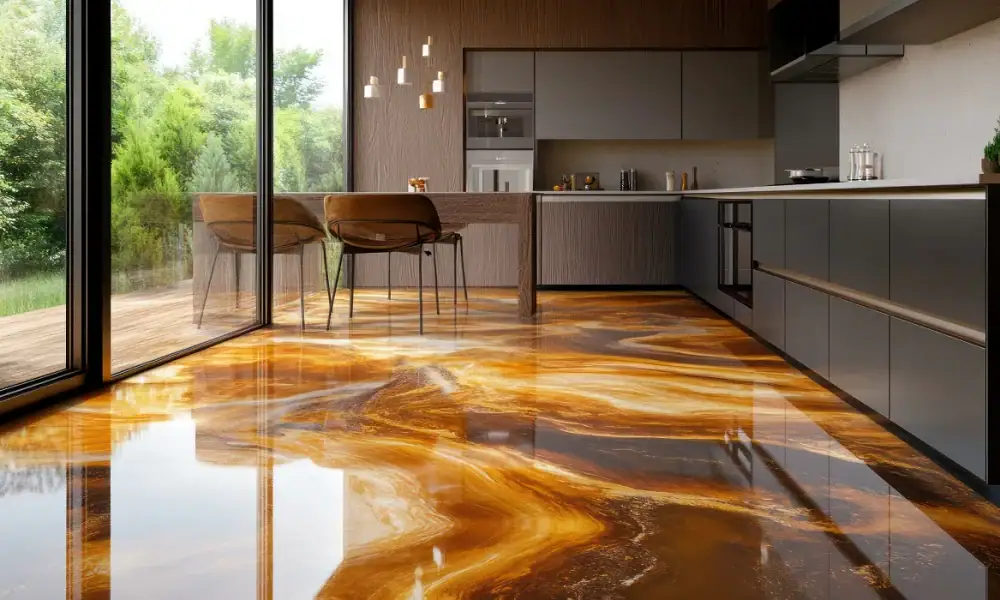
Metallic epoxy restaurant floor finishes that create fluid, three-dimensional surface effects ranging from polished-silver industrial glamour to warm copper and bronze tones suited to upscale Pakistani dining aesthetics. A metallic epoxy restaurant floor in a dining area photographs extraordinarily well — an important consideration in an era when a restaurant’s Instagram presence is a meaningful marketing asset.
Solid colour self-leveling epoxy in carefully chosen RAL shades that align with a restaurant’s brand palette — a precisely specified colour floor that creates visual cohesion between the interior design language and the floor surface.
Epoxy resin floor for eateries incorporating graphic elements — logos, patterns, directional typography, or decorative borders — cast directly into the epoxy system and sealed under a clear topcoat for permanent, wear-resistant floor graphics.
Abrasion-resistant dining floor performance is essential across all of these decorative options. Chair and stool legs dragged repeatedly across a floor surface that lacks abrasion resistance will produce scratching and surface dulling within months of opening. Specifying an abrasion-resistant dining floor through a correctly formulated polyurethane or polyurethane-modified epoxy topcoat ensures that the floor’s visual quality is maintained through years of heavy service.
Service Corridors and Pass-Through Areas
The service corridor — the zone between kitchen and dining area where waitstaff move at speed carrying food and beverages — combines the safety demands of the kitchen with a higher aesthetic standard than a purely utilitarian zone requires. A durable floor for high-traffic dining zones in this area must be genuinely slip-resistant, easy to clean rapidly between covers, and visually consistent with either the kitchen or dining area specification depending on customer sight lines.
A medium-build self-leveling epoxy at 2.5mm with a light anti-slip aggregate and a finish colour that bridges the kitchen and dining area palettes performs excellently in this zone. The floor coating for food businesses in service corridor applications should also be specified for resistance to hot liquid spillage, since beverage spills in transit are a routine occurrence in this zone.
Cold Rooms and Refrigerated Storage
Cold rooms and chiller areas present a specific epoxy flooring challenge: thermal cycling. As cold room doors open and close, the floor surface in the threshold zone cycles repeatedly between ambient temperature and the cold room temperature. This thermal cycling creates expansion and contraction stress in the floor system that inadequately specified coatings cannot tolerate, leading to delamination and cracking at the threshold transition.
Waterproof restaurant flooring systems for cold room applications in Pakistani restaurants should use a cold-tolerant epoxy formulation. With a dedicated expansion joint detail at the cold room threshold. The waterproof restaurant flooring characteristic is essential in cold room environments. Where condensation on walls and ceiling drips onto the floor continuously. Standard epoxy systems bonded to adequately prepared concrete substrates are fully waterproof. No moisture passes through the coating to the substrate. But the thermal cycling tolerance requires specific material selection.
Customer Washrooms
Customer washrooms in Pakistani restaurants are high-footfall, high-moisture zones that require both robust hygiene performance and an appropriate aesthetic standard. A non-porous restaurant floor in washroom areas eliminates the grout-line contamination. That makes tiled washroom floors a hygiene maintenance problem. While the waterproof and chemical-resistant. Properties of epoxy make it fully compatible with the cleaning protocols washrooms require.
Washroom epoxy floors in restaurant environments are typically specified with a fully anti-slip aggregate broadcast at a medium profile. It coarser than the kitchen finish to accommodate the risk of water tracked in from hand-washing. But smooth enough to maintain the professional appearance appropriate to a customer-facing area. An anti-bacterial restaurant floor specification using an antimicrobial-additive topcoat is available for washroom areas in restaurants. Operating to international brand standards or undergoing food safety certification.
Epoxy Flooring Systems Suited to Pakistani Restaurant Environments
Several distinct epoxy system types are available in the Pakistan market, and understanding which system suits which zone and operational profile helps restaurant owners make informed specifications:
Self-Leveling Epoxy — The Foundation System
Self-leveling epoxy is the most widely deployed system across Pakistani restaurant projects, used in both kitchen and dining contexts. The liquid consistency of the mixed material allows it to flow across a prepared substrate and achieve a uniform thickness without the trowelling marks that characterise manually applied systems. This characteristic makes self-leveling epoxy restaurant installations the baseline specification for hygiene-critical environments where surface uniformity is both a cleanliness and an appearance requirement.
Applied at 2–4mm depending on zone classification, self-leveling epoxy restaurant systems achieve the seamless floor for commercial kitchen environments that food-safety compliance demands. In dining areas, the same system delivers the smooth, seamless substrate over which decorative topcoat finishes are applied.
Broadcast Anti-Slip System — Safety-Critical Zones
In kitchen zones, the broadcast anti-slip system deposits dry aggregate. It typically washed aluminium oxide or graded silica — into a wet epoxy base coat. The aggregate particles are partially embedded in the epoxy matrix and locked in place by a clear or pigmented topcoat. However, creating a permanently textured, slip-resistant restaurant floor that cannot be mopped away or worn smooth over time. This is categorically different from anti-slip paint treatments that wear off within months under commercial kitchen foot traffic.
Metallic Epoxy System — Dining Area Feature Floors

The metallic epoxy restaurant floor system uses metallic pigment powders blended into a clear or lightly tinted epoxy resin base. During application, the installer manipulates the wet material using tools, air, and deliberate movement. To create unique flowing patterns in the metallic pigment. No two metallic epoxy floors are identical. Each installation is genuinely unique, which adds to their appeal as a restaurant floor design Pakistan element that cannot be replicated by competitors.
Metallic epoxy systems are typically applied at 1.5–2mm and sealed with a UV-stable polyurethane topcoat. To prevent the amber toning that unprotected epoxy develops under artificial light over time.
Epoxy Resin Floor for Eateries with Graphic Integration
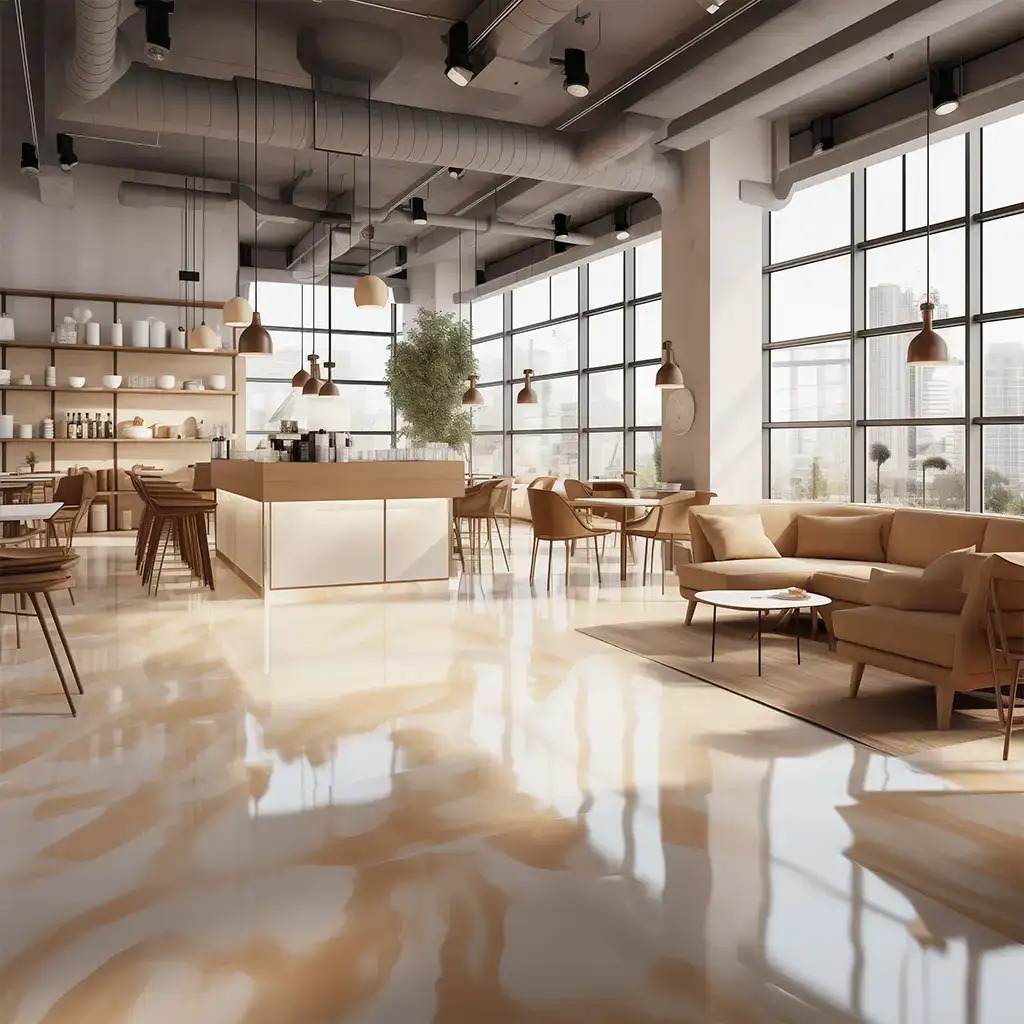
For branded restaurant concepts — QSR chains, franchise operations, or restaurant groups with strong visual identity programmes — an epoxy resin floor for eateries with integrated floor graphics offers a distinctive and permanent brand implementation that vinyl graphics and tile inlays cannot match for durability or visual quality. Brand logos, floor zone identifiers, and directional graphics are applied using compatible epoxy-based pigment systems between coats, then sealed under the final topcoat for complete wear resistance.
Restaurant Epoxy Flooring Installation Services Pakistan
Modern restaurants in Pakistan require flooring that can handle heavy foot traffic, constant cleaning, grease exposure, and temperature changes without losing durability or hygiene performance. Our restaurant epoxy flooring installation services Pakistan are designed specifically for commercial kitchens, dining areas, cafés, bakeries, fast food outlets, and industrial food preparation zones.
We provide seamless, non-porous, and high-strength epoxy flooring systems that improve hygiene standards, reduce maintenance costs, and enhance the overall presentation of your restaurant space.
Hygienic & Food-Safe Flooring Systems
Restaurant flooring must meet strict hygiene requirements. Epoxy flooring creates a seamless, joint-free surface that prevents bacteria, moisture, and grease from penetrating the floor.
Our systems are designed to:
- Meet food safety hygiene standards
- Resist oil, grease, and chemical spills
- Prevent bacterial growth in joints or cracks
- Allow easy daily cleaning and sanitization
This makes epoxy one of the most reliable flooring choices for commercial kitchens and food preparation areas.
Heavy-Duty Flooring for Kitchens & Dining Areas
Our restaurant epoxy flooring installation services Pakistan are engineered to withstand:
- Continuous foot traffic
- Heavy kitchen equipment loads
- Hot oil spills and temperature fluctuations
- Cleaning chemicals and disinfectants
- Constant movement of trolleys and staff
For kitchen zones, we apply anti-slip broadcast systems to ensure staff safety even in wet and greasy conditions.
Anti-Slip Commercial Kitchen Epoxy Flooring
Safety is critical in restaurant environments. Our anti-slip epoxy flooring systems include:
- Quartz or silica aggregate broadcast
- Slip-resistant topcoats
- Wet-area safety enhancement
- Customized grip levels based on kitchen requirements
This ensures a safe working environment and reduces the risk of accidents in high-pressure kitchen operations.
Complete Installation Process
Our professional installation process includes:
- Concrete surface grinding and leveling
- Crack and joint repair
- Moisture testing and preparation
- Primer application for strong adhesion
- Epoxy base coat and self-leveling system
- Anti-slip aggregate broadcasting (for kitchens)
- Decorative or high-gloss topcoat finishing
Each layer is carefully applied to ensure maximum bonding strength and long service life.
Heat, Chemical & Grease Resistance
Restaurant floors are exposed to extreme conditions daily. Our epoxy flooring systems are resistant to:
- Hot water and steam cleaning
- Cooking oil and grease spills
- Cleaning chemicals and disinfectants
- Acidic food ingredients and stains
For high-heat zones near fryers, ovens, and tandoors, we can install heat-resistant epoxy or ceramic-reinforced coatings for additional protection.
Fast Installation with Minimal Downtime
We understand that restaurant closures impact revenue. Our installation timeline is optimized for commercial operations:
- Small to medium kitchens: 3–5 days installation
- Full curing for heavy use: 5–7 days
- Light foot traffic allowed after 24 hours
We also offer phased installation for dining and kitchen areas to minimize operational disruption.
Restaurant Epoxy Flooring Price Pakistan — 2026 Price Guide
Epoxy flooring cost Pakistan for restaurant projects depends on the system specified, the floor area, the condition of the existing substrate, and the city of installation. The following 2026 indicative pricing covers the most common restaurant zones:
| Zone / Application | System | Approximate Cost PKR per sq ft |
|---|---|---|
| Commercial kitchen — broadcast anti-slip, 3mm | Food-grade epoxy with coved skirting | PKR 600–950 |
| Commercial kitchen — self-leveling, 2.5mm | Standard hygienic epoxy | PKR 450–700 |
| Dining area — solid colour self-leveling | Decorative epoxy, 2mm | PKR 400–600 |
| Dining area — metallic finish | Metallic epoxy, 2mm + UV topcoat | PKR 900–1,500 |
| Service corridor — anti-slip self-leveling | Medium-build system, 2.5mm | PKR 450–700 |
| Cafe/QSR — full floor decorative epoxy | Branded colour system | PKR 500–850 |
| Cold room — thermal-tolerant system | Specialist cold-room epoxy | PKR 700–1,100 |
| Washroom — anti-slip with anti-bacterial topcoat | Hygiene epoxy | PKR 550–850 |
| Floor graphics (per sq ft of graphic area) | Embedded epoxy graphic | PKR 350–700 |
For a 2,000 sq ft restaurant with 800 sq ft of commercial kitchen and 1,200 sq ft of dining area. A realistically budgeted 2026 installation using mid-range specifications. It would typically fall between PKR 1.2 million and PKR 2.1 million depending on design complexity and substrate condition. This epoxy flooring cost Pakistan figure. That should be evaluated against the ongoing maintenance cost, health inspection compliance risk. However, customer-facing aesthetic quality of conventional tile alternatives over a five to seven-year comparison period.
For cafe epoxy flooring Pakistan projects of smaller footprint — typically 300–800 sq ft. The fixed mobilisation cost of the contractor means a higher per-sq-ft rate applies. A small cafe project of 400 sq ft with a decorative dining area and a compact open kitchen. It can typically be completed for PKR 300,000 to PKR 600,000 depending on specification.
Restaurant Epoxy Flooring Applications
Our systems are ideal for:
- Commercial kitchens
- Fine dining restaurants
- Fast food chains
- Bakeries and pastry shops
- Cafés and coffee shops
- Hotel kitchens
- Food courts and cloud kitchens
Epoxy Flooring for Specific Restaurant Formats in Pakistan
Pakistan’s food service landscape includes a diverse range of formats, each with distinct flooring requirements:
Full-Service and Fine Dining Restaurants
In upscale dining environments — the kind found in DHA Lahore, Clifton Karachi, or F-7 Islamabad. The floor is a central element of the interior design narrative. A metallic epoxy restaurant floor with a bespoke colour treatment creates the impression of a custom-designed surface that justifies the premium positioning of the restaurant. The abrasion-resistant dining floor performance ensures that this investment maintains its visual quality through years of heavy dining service.
Restaurant floor design Pakistan at the fine dining level should involve the restaurant’s interior designer in the epoxy specification process. Since colour matching, sheen level, and finish texture. All interact with the lighting design and furniture selection to create a coherent guest experience.
Fast Food Outlets and QSR Chains
An epoxy floor for fast food outlets serves a different master: operational efficiency above all else. High diner turnover, frequent deep cleaning, potential for wet tray spills, and the need for a clean, modern appearance. That communicates food safety credentials all point toward a medium-build self-leveling epoxy in a branded colour or neutral, easily cleanable surface. Floor coating for food businesses in the QSR format should be specified for rapid cleanability. The floor must be mopped and return to service-ready standard quickly between peak service periods.
Many of Pakistan’s QSR operators specifying cafe epoxy flooring Pakistan across multiple outlets are standardising on epoxy specifications that allow consistent roll-out across their estate, ensuring both operational consistency and brand consistency.
Hotel Restaurants and Banquet Kitchens

Hotel kitchen epoxy floor specifications are typically the most demanding in the hospitality sector. A hotel kitchen epoxy floor serves multiple food preparation functions simultaneously — pastry, hot kitchen, cold preparation, and plating. Each generating different types of floor contamination. The floor coating for food businesses at hotel scale must satisfy international brand standards. Its accommodate the movement of heavy bulk food equipment, and maintain its integrity. Through the aggressive daily cleaning protocols that a hotel kitchen requires.
At this level, a hotel kitchen epoxy floor specification typically involves a full mortar-base system in high-traffic kitchen zones. Transitioning to a self-leveling epoxy with broadcast aggregate across general preparation areas. All unified under a consistent topcoat colour and anti-slip profile. The food-safe epoxy flooring certification documentation provided by the contractor is a standard requirement for international hotel brand compliance.
Street-Side and Casual Dining Cafes
Pakistan’s growing cafe culture has created a large and design-conscious market for cafe epoxy flooring Pakistan. Cafes in particular benefit from the visual impact available through decorative epoxy. The look of a polished, seamless concrete floor, or a warm terrazzo-effect epoxy surface, or a clean matte white floor. That makes the food photography pop — at a cost that is accessible even for independent operators.
Food-safe epoxy flooring in a cafe context also provides the hygiene performance that the growing segment of health-conscious Pakistani cafe visitors expects and that regulators increasingly require for premises serving food.
Maintaining Restaurant Epoxy Floors in Pakistan — Keeping Your Investment Performing
Proper maintenance extends the service life of a restaurant epoxy floor significantly. It keeps both the hygiene performance and the visual quality at the level the original installation achieved.
For commercial kitchen epoxy floors, the daily cleaning protocol should use a pH-appropriate degreaser. It diluted to the manufacturer’s recommended concentration — not undiluted. As even a chemical-resistant kitchen floor can be affected by prolonged contact with highly concentrated caustic agents. Hot water at 60–70°C increases cleaning efficiency significantly and is fully compatible with correctly specified epoxy systems. A mechanical floor scrubber significantly outperforms manual mopping in terms of contamination removal.
For decorative dining area and cafe epoxy flooring Pakistan, the daily protocol requires only a neutral-pH floor cleaner and a soft-pad scrubber. Abrasive cleaning pads or steel wool must never be used on the topcoat surface of a dining area epoxy floor. Any furniture with bare metal legs should be fitted with felt or rubber floor protectors to prevent point-contact scratching of the topcoat.
Periodic inspection for any chips, cracks, or surface wear concentrated in high-traffic zones allows early repair before damage propagates. A small local epoxy repair carried out within weeks of damage appearing costs a fraction of the cost of a full zone recoat. Making proactive floor inspection a sound operational practice for any Pakistani restaurant operator.
Why Pakistani Restaurants Are Switching From Tiles to Epoxy
The comparison between conventional tiled floors and restaurant epoxy flooring in Pakistan. It consistently resolves in epoxy’s favour for food-service environments. It is not a close contest on the criteria that matter most to restaurant operators.
Tiles introduce grout lines that accumulate grease and bacteria regardless of cleaning frequency. They crack under the point loads of heavy catering equipment. Each crack and each damaged tile creates a hygiene risk, a trip hazard, and a maintenance cost. The replacement process — involving tile removal, substrate preparation, re-tiling, and grouting. It disrupts kitchen operations significantly and never quite matches the surrounding tiles in colour or texture, creating a patchwork appearance over time.
Epoxy eliminates every one of these failure modes. The hygienic floor for restaurants that epoxy provides is genuinely seamless. There are no joints to crack, no grout to contaminate, no individual sections to replace. When the floor eventually requires a maintenance refresh after many years of service. A clean and recoat of the existing system can typically be completed in a fraction of the time and cost of a tile replacement project.
For dining areas specifically, the design possibilities available through decorative epoxy for dining areas. Simply have no equivalent in the tile world at comparable cost. A metallic epoxy restaurant floor achieves a visual standard that no tile product can replicate at the same installed cost. It does so with a surface that is easier to clean and more durable under dining service conditions.
Restaurant Epoxy Flooring Contractors Pakistan
As experienced restaurant epoxy flooring contractors Pakistan, we work with:
- Restaurant owners and franchises
- Café and bakery chains
- Hotel kitchens and banquet halls
- Fast food outlets and food courts
- Cloud kitchens and delivery kitchens
We provide end-to-end flooring solutions from surface preparation to final topcoat application, ensuring long-term durability and performance.
Restaurant Epoxy Flooring Services Across Pakistan
We provide restaurant epoxy flooring installation services Pakistan in major cities including Lahore, Karachi, Islamabad, Rawalpindi, Faisalabad, Multan, Peshawar, and Sialkot.
Our team ensures every project is customized according to kitchen layout, hygiene requirements, traffic load, and design preferences to deliver a long-lasting professional flooring system.
Conclusion: Restaurant Epoxy Flooring in Pakistan Is a Competitive Advantage
In a restaurant market as competitive and design-conscious as Pakistan’s has become, every element of the physical environment. It contributes to or detracts from the dining proposition. The floor — which every customer sees the moment they enter, which every kitchen staff member stands on for their entire shift. Which every health inspector scrutinises during every visit. It deserves specification that matches the ambition of the restaurant concept it serves.
Restaurant epoxy flooring in Pakistan provides the grease resistance, slip resistance, and hygienic floor for restaurants that commercial kitchen compliance. It demands, together with the decorative versatility and durability that makes it equally suited to the dining areas. Where the guest experience is made or broken. The epoxy flooring cost Pakistan pricing available in 2026, compared against the lifecycle cost of maintained tile systems and the competitive value of a floor. That communicates quality, makes the investment calculation straightforward for most restaurant formats.
epoxyflooring.pk installs restaurant and commercial kitchen epoxy flooring across Pakistan — in Lahore, Karachi, Islamabad, Faisalabad, and beyond. Contact us for a site assessment, zone-by-zone specification, and a 2026 project quote.
FAQ’S
Can epoxy flooring withstand the temperatures in a Pakistani commercial kitchen?
Standard commercial-grade epoxy systems tolerate continuous service temperatures up to 60–70°C and brief thermal shock from hot liquid spills up to 100°C without delaminating or softening. For areas directly adjacent to fryers or tandoors where radiant heat is extreme, a specialist thermal-resistant epoxy formulation or ceramic-filled topcoat can be specified. Your contractor should confirm the thermal rating of the specific system proposed for your kitchen.
How long does restaurant epoxy floor installation take, and when can we open?
A typical 1,000 sq ft restaurant kitchen and dining area can be prepared and coated within 4–6 working days from surface preparation through to final topcoat. The floor can accept careful foot traffic from cleaning staff within 24 hours of the final topcoat, but should not be subject to the full load of kitchen equipment and service operations for a minimum of 5–7 days to allow full chemical cure. Epoxy floor installation Pakistan for restaurant projects is best scheduled during a planned closure or fitout period rather than attempted as a live-restaurant operation.
Will epoxy flooring in our dining area scratch from chairs and table legs?
A correctly specified abrasion-resistant dining floor using a polyurethane-modified topcoat has excellent scratch resistance. However, bare metal chair and table legs dragged repeatedly across any hard floor surface will eventually produce surface marks. Fitting felt or rubber glides to all furniture legs, and avoiding dragging heavy furniture rather than lifting it, will preserve the floor’s visual quality indefinitely. Restaurant floor design Pakistan with decorative epoxy should include this practical furniture specification in the handover notes.
Is epoxy flooring slippery for kitchen staff when the floor is wet?
Without aggregate, a polished epoxy surface can be slippery when wet — which is why the commercial kitchen epoxy floor specification always incorporates an anti-slip aggregate broadcast. A properly installed broadcast anti-slip system provides a Pendulum Test Value (PTV) that meets and exceeds the wet slip resistance requirements for commercial kitchen environments. This makes a slip-resistant restaurant floor with broadcast aggregate categorically safer than smooth tiles or painted concrete when wet.
Does epoxy flooring comply with Pakistani food safety and municipal health inspection requirements?
A properly installed and documented non-porous restaurant floor using food-safe epoxy materials fully satisfies the surface hygiene requirements applied by Pakistani municipal health inspectors. Contractors who specialise in restaurant and food-service epoxy flooring can provide material safety data sheets and food-contact compliance documentation that forms a solid basis for demonstrating compliance to inspectors. This documentation is particularly valuable for restaurant operators pursuing international certification or operating under franchise agreements with international F&B brands.