
Solvent Free Epoxy Flooring: What It Means, Benefits & Applications
Discover why solvent-free epoxy flooring is becoming a preferred solution for homes, hospitals, factories and commercial spaces in Pakistan. Learn how it works, its benefits and where it can be used.
Modern construction projects increasingly require flooring systems that offer durability, easy maintenance and strong performance. Solvent-free epoxy flooring is one option used in industrial, commercial, healthcare and residential environments.
Unlike conventional solvent-containing coatings, solvent-free epoxy systems do not rely on solvent evaporation to form the final coating film. This can allow greater film build and reduced solvent-related emissions during application, depending on the specific product formulation.
When properly specified and installed, solvent-free epoxy can create a seamless and durable surface suitable for demanding flooring applications.
What Is Solvent Free Epoxy Flooring?
Solvent-free epoxy flooring is made using an epoxy resin and hardener system formulated without added volatile solvents. Many products are also described as high-solids or 100% solids epoxy systems.
During curing, the epoxy resin and hardener react chemically to create a hard and durable surface. Unlike solvent-based coatings, there is little or no solvent evaporation contributing to the reduction of coating thickness.
- Formulated without added volatile solvents
- Can provide high film build per application
- Reduced solvent evaporation during curing
- Creates a seamless and durable flooring surface
- Suitable for many industrial and commercial applications
- Available in systems designed for chemical and abrasion resistance
Solvent Free vs. Solvent Based Epoxy Flooring
The main difference between solvent-free and solvent-based epoxy is the formulation and how the coating develops its final thickness during curing.
| Feature | Solvent-Free Epoxy | Solvent-Based Epoxy |
|---|---|---|
| Solvent Content | No added volatile solvents | Contains solvents in the formulation |
| VOC Characteristics | Typically lower depending on the product | Can be higher depending on solvent content |
| Odor During Application | Often reduced | Can have a stronger odor |
| Film Build | Can achieve high build per coat | May require additional coats |
| Thickness During Curing | Less reduction from solvent evaporation | Thickness can reduce as solvents evaporate |
| Applications | High-build industrial and indoor applications | Depends on product and project requirements |
Benefits of Solvent Free Epoxy Flooring
Solvent-free epoxy systems offer several advantages when selected correctly for the flooring environment.
Reduced Solvent Emissions
Solvent-free formulations reduce reliance on volatile solvents, making them suitable for projects where lower solvent emissions are an important consideration.
High Build Thickness
High-solids systems can often achieve greater dry film thickness per application compared with coatings that lose part of their volume through solvent evaporation.
Durable Surface
Properly installed epoxy creates a tough and durable protective surface suitable for many high-traffic environments.
Seamless Flooring
Epoxy creates a continuous surface with fewer joints, helping make the floor easier to clean and maintain.
Chemical Resistance
Selected epoxy systems can be designed to resist oils, chemicals and industrial substances, depending on the specific formulation.
Strong Adhesion
With proper concrete preparation and compatible materials, epoxy can develop strong adhesion to the flooring substrate.
Applications of Solvent Free Epoxy Flooring
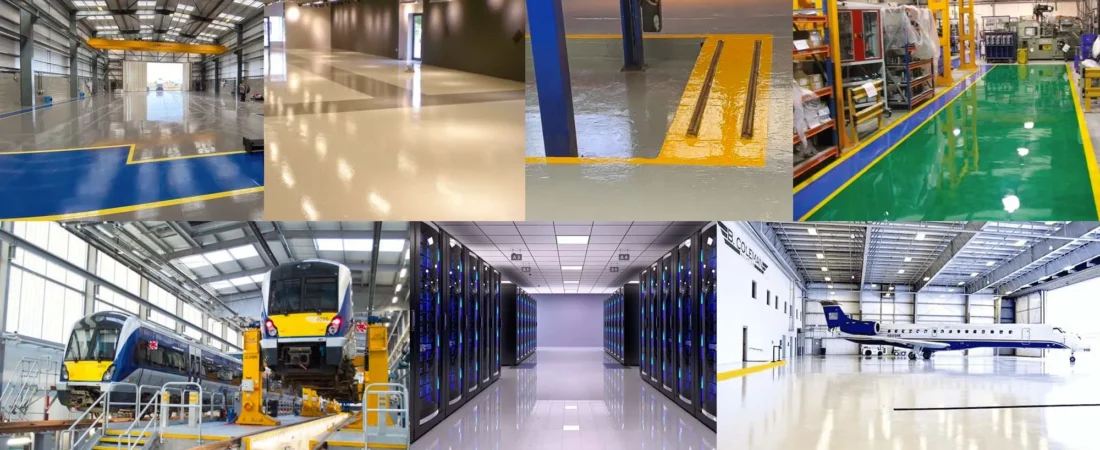
Solvent-free epoxy flooring can be used in many environments. The final system should be selected according to traffic, chemical exposure, hygiene, moisture conditions and required floor performance.
Factories
Industrial floors can require durable coatings capable of handling machinery, equipment, foot traffic and operational wear.
Warehouses
Suitable systems can provide durable flooring for warehouses exposed to regular traffic and material handling activities.
Hospitals & Clinics
Seamless and easy-to-clean flooring can be useful in healthcare environments where hygiene and maintenance are important.
Laboratories
Selected systems can be designed for environments where chemical resistance and easy cleaning are required.
Commercial Buildings
Offices, showrooms, retail spaces and other commercial facilities can benefit from a durable and seamless epoxy floor finish.
Residential Areas
Solvent-free epoxy systems can also be considered for garages, kitchens and other residential areas requiring a durable surface.
Technical Advantages of Solvent Free Epoxy
High Film Build
Solvent-free epoxy can provide a high-build coating because the system does not depend on solvent evaporation to create the final cured film.
Chemical Resistance
Certain epoxy formulations are designed to resist oils, fuels, acids, alkalis and other industrial chemicals. Chemical resistance should be verified against the actual chemicals used at the project site.
Abrasion Resistance
Properly specified epoxy systems can provide a hard protective layer for concrete floors exposed to daily traffic and operational wear.
Easy Maintenance
The seamless nature of epoxy flooring can reduce joints where dust and dirt accumulate, making routine cleaning easier.
Different Finish Options
Depending on the selected system, solvent-free epoxy flooring can be produced in different colors and finishes, including smooth and slip-resistant surfaces.
Solvent Free Epoxy Flooring Installation Process
Surface preparation is one of the most important parts of epoxy flooring installation. A high-quality epoxy system can still fail if the concrete is weak, contaminated or improperly prepared.
Inspect the Concrete Floor
The substrate is checked for cracks, weak areas, contamination, previous coatings and moisture-related problems.
Prepare the Surface
Mechanical preparation such as grinding is used to remove weak material, contamination and unsuitable coatings while preparing a suitable surface for epoxy adhesion.
Repair Cracks & Damaged Areas
Cracks, holes and damaged concrete areas are repaired before the new flooring system is applied.
Apply a Compatible Primer
Where required, a compatible primer is applied to help establish a strong bond between the prepared concrete and the epoxy system.
Apply Solvent Free Epoxy
The epoxy resin and hardener are mixed according to the manufacturer’s specified ratio and applied at the required thickness.
Apply Topcoat if Required
A compatible topcoat may be applied depending on the required appearance, protection, chemical resistance or slip resistance.
Allow Proper Curing
The completed floor should be allowed to cure according to the product requirements before being exposed to the intended foot or vehicle traffic.
Solvent Free Epoxy Flooring Price in Pakistan
The cost of solvent-free epoxy flooring depends on the selected system, floor condition, preparation requirements, total area and required coating thickness.
Factors That Affect the Price
- Condition of the existing concrete floor
- Surface preparation requirements
- Crack and concrete repair work
- Total project area
- Required epoxy thickness
- Type and quality of the epoxy system
- Primer and topcoat requirements
- Required slip-resistant finish
- Site access and application conditions
How to Maintain Solvent Free Epoxy Flooring
Regular maintenance can help maintain the appearance and performance of your epoxy flooring system.
- Remove dust and loose dirt regularly.
- Clean the floor using suitable cleaning products.
- Clean spills as soon as practical.
- Avoid aggressive chemicals unless approved for the flooring system.
- Use protective measures under heavy equipment where necessary.
- Inspect high-traffic areas for signs of wear.
- Repair damaged areas before the problem becomes larger.
Common Misconceptions About Solvent Free Epoxy
Solvent-Free Always Means VOC-Free
VOC characteristics depend on the complete product formulation. Technical documentation should always be checked for the specific product being used.
It Is Automatically Stronger Than Every Epoxy
Flooring performance depends on the formulation, coating thickness, substrate preparation and installation quality.
It Is Only Used in Factories
Solvent-free epoxy can also be suitable for commercial, institutional and residential applications when correctly specified.
No Solvent Means No Preparation Is Needed
Surface preparation, moisture control, correct mixing and proper curing remain essential for successful epoxy flooring installation.
Solvent Free Epoxy Flooring in Pakistan
Solvent-free epoxy flooring is suitable for projects where durability, seamless performance and reduced solvent emissions are important considerations.
Before selecting a flooring system, the project should be assessed for concrete condition, moisture, expected traffic, chemical exposure, hygiene requirements and required slip resistance.
The correct epoxy system should always be selected according to the actual environment rather than choosing a coating based only on appearance or price.
Looking for Solvent Free Epoxy Flooring in Pakistan?
Get professional guidance on selecting the right epoxy flooring system for your factory, warehouse, hospital, commercial space or residential project. Proper surface preparation and system selection are essential for long-term floor performance.
Request a Free ConsultationFrequently Asked Questions About Solvent Free Epoxy Flooring
What is solvent-free epoxy flooring?
Solvent-free epoxy flooring uses an epoxy system formulated without added volatile solvents. Many systems are high-solids or 100% solids, depending on the specific product.
Is solvent-free epoxy suitable for indoor use?
Yes, suitable solvent-free epoxy systems can be used indoors. Product safety, ventilation and application requirements should always be followed.
Is solvent-free epoxy durable?
A properly specified and installed solvent-free epoxy system can provide a durable flooring surface. Performance depends on the formulation, thickness, concrete preparation and application quality.
What is the difference between solvent-free and solvent-based epoxy?
Solvent-based epoxy contains solvents that can evaporate during curing, while solvent-free epoxy is formulated without added volatile solvents. This can affect odor, VOC characteristics and coating build.
Can solvent-free epoxy be used in factories?
Yes. Suitable solvent-free epoxy systems can be used in factories, warehouses and industrial facilities. The final system should be selected according to traffic and chemical exposure.
Is solvent-free epoxy chemical resistant?
Many epoxy systems offer chemical resistance, but the exact resistance depends on the product and the chemicals involved. The flooring system should be selected based on actual site exposure.
How much does solvent-free epoxy flooring cost in Pakistan?
The cost depends on the floor area, concrete condition, surface preparation, coating thickness and selected epoxy system. A site-based quotation provides the most accurate project price.
Does solvent-free epoxy require a primer?
Some systems require a compatible primer while others may have different application requirements. Always follow the selected manufacturer’s flooring system specification.
Related Epoxy Flooring Services
Conclusion
Solvent-free epoxy flooring is a practical option for projects requiring a durable, seamless and high-build protective floor with reduced reliance on volatile solvents.
Its performance depends on selecting the correct product for the environment and ensuring that the concrete is properly assessed, prepared and coated according to the required installation procedure.
Whether used in a factory, warehouse, hospital, commercial building or residential space, proper surface preparation and professional application remain the foundation of a long-lasting solvent-free epoxy floor.