
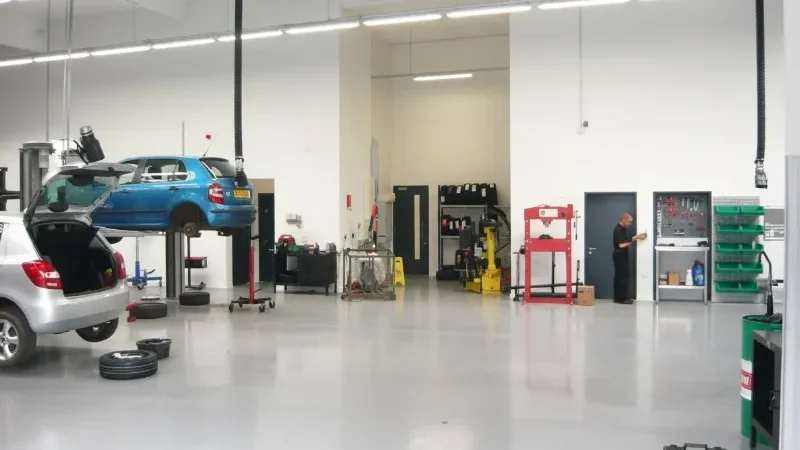
Service Station Flooring in Pakistan: Best Flooring for Auto Workshops & Car Service Centers
Service station flooring must withstand oil spills, automotive chemicals, vehicle traffic, tools, impact and constant cleaning. A standard concrete floor can become dusty, stained and difficult to maintain when it is exposed to daily workshop operations.
Professional epoxy, PU and other industrial flooring systems can create a durable, seamless and easier-to-clean surface for automotive workshops, car service centers, dealerships, garages, oil-change facilities and maintenance areas.
Unicorn Flooring describes its service station flooring as a durable, oil- and chemical-resistant surface designed for safety, easy maintenance and long-term performance in high-traffic automotive areas. :contentReference[oaicite:0]{index=0}
What Is Service Station Flooring?
Service station flooring is an industrial flooring system designed for automotive workshops and vehicle maintenance environments. These floors need to perform under conditions that are significantly more demanding than those found in ordinary commercial buildings.
A vehicle service center may experience oil, grease, brake fluid, coolants, cleaning chemicals, fuel-related contamination, metal tools, vehicle jacks, heavy equipment and constant pedestrian movement.
A properly specified flooring system helps create a more durable, professional and maintainable working environment.
Why Service Stations Need Specialized Flooring
Oil Resistance
Automotive workshops regularly deal with engine oil, grease and other petroleum-related contaminants. The flooring should be selected to resist the substances used in the facility.
Chemical Resistance
Coolants, cleaning products, battery-related chemicals and other workshop substances can attack unsuitable floor surfaces.
Heavy Traffic
Vehicle workshops experience repeated movement of cars, technicians, tools, equipment and service machinery.
Easy Cleaning
A seamless floor is easier to clean than damaged or highly porous concrete with oil and dirt trapped inside the surface.
Slip Resistance
Workshop floors can become contaminated with water, oil and cleaning liquids, making traction an important consideration.
Professional Appearance
A clean, well-finished floor can improve the appearance of a service center and create a more professional working environment.
Best Flooring Options for Service Stations
Different areas of an automotive facility may require different flooring systems. The most suitable option depends on traffic, chemical exposure, vehicle loads, impact, temperature and the condition of the existing floor.
Heavy-Duty Epoxy Flooring
A popular choice for workshops because it provides a seamless, durable and easy-to-clean surface when correctly specified and installed.
Polyurethane Flooring
PU systems can be considered where flexibility, abrasion resistance, chemical exposure and demanding industrial conditions are important.
Epoxy Mortar Flooring
Suitable for areas requiring a thicker, heavy-duty system and greater resistance to mechanical wear and impact.
Anti-Slip Epoxy Flooring
Textured aggregate can be incorporated into the coating system where additional traction is required.
Epoxy Flooring for Car Service Centers
Epoxy flooring is one of the most practical solutions for many vehicle workshops and service centers. It forms a hard, seamless surface over a properly prepared concrete substrate.
The system can be designed with different thicknesses, primers, body coats, aggregates and topcoats according to the expected service conditions.
- Seamless appearance with no conventional tile joints.
- Good resistance to many automotive oils and chemicals when correctly specified.
- Easy routine cleaning.
- Good abrasion resistance for busy workshops.
- Available in multiple colours and finishes.
- Can incorporate anti-slip aggregates.
- Helps reduce dusting from untreated concrete.
- Creates a professional industrial appearance.
PU Flooring for Automotive Service Stations
Polyurethane flooring can be considered for demanding service environments where mechanical wear, chemical exposure, temperature changes or flexibility are important design considerations.
PU flooring is particularly useful when the floor requires a combination of durability and resilience. The exact PU formulation and system thickness should be selected according to the workshop’s operating conditions.
Anti-Slip Flooring for Service Stations
Slip resistance is particularly important in automotive workshops because water, oil, grease and cleaning liquids can make smooth surfaces hazardous.
An anti-slip flooring system can incorporate graded aggregate into the resin coating to create a textured surface. The texture should be selected carefully because excessively rough floors can become harder to clean.
Light Texture
Suitable where routine cleaning and moderate traction are the primary requirements.
Medium Texture
A practical option for many general automotive workshop areas.
Heavy Texture
Can be considered for areas with significant oil and water contamination where maximum traction is required.
Service Station Flooring Areas
Vehicle Service Bays
Require durable, oil-resistant and easy-to-clean flooring capable of handling vehicles, tools and workshop traffic.
Oil Change Area
Should prioritize oil resistance, slip resistance and easy cleanup.
Mechanical Workshop
Heavy-duty flooring helps withstand equipment, tools, vehicle movement and repeated impact.
Car Wash Area
Requires a water-resistant, slip-resistant system with suitable drainage and substrate preparation.
Tyre Service Area
Flooring should withstand vehicle movement, equipment loads and rubber-related contamination.
Parts & Maintenance Area
A seamless, easy-to-clean surface can help maintain a cleaner and more organized workshop environment.
Service Station Flooring Thickness
Flooring thickness should be selected according to the actual loading and operating conditions rather than applying one thickness to every workshop.
| Application | Typical System Approach | Key Requirement |
|---|---|---|
| Light Workshop | Thin to medium epoxy coating | Dust control, appearance and basic chemical resistance |
| General Service Bay | Medium-duty epoxy system | Traffic, oil resistance and easy cleaning |
| Heavy Workshop | Heavy-duty epoxy or PU system | Mechanical wear and impact resistance |
| High Chemical Exposure | Specialized chemical-resistant system | Resistance to specified chemicals |
| Oil/Water Contamination | Textured anti-slip system | Traction and cleanability |
The final thickness should be determined after a site assessment that considers the concrete condition, vehicle loads, equipment, impact, chemical exposure and expected service life.
Concrete Floor Preparation for Service Station Flooring
Surface preparation is one of the most important stages of an industrial flooring installation. Even a high-quality resin system can fail if the concrete underneath is weak, contaminated or unsuitable.
- Inspection: Check the concrete for cracks, weak areas, contamination and moisture.
- Cleaning: Remove oil, grease, dirt, dust and other contaminants.
- Mechanical Preparation: Grind, shot-blast or otherwise prepare the surface using an appropriate method for the selected flooring system.
- Crack Repair: Repair suitable cracks and damaged areas before coating.
- Levelling: Correct significant uneven areas where required.
- Primer: Apply the compatible primer system to establish adhesion.
- Resin Layers: Install the specified body coat, broadcast aggregate or additional layers as required.
- Topcoat: Apply the appropriate protective and finishing layer.
Oil Contamination: A Major Challenge for Workshop Floors
Oil contamination is one of the most common problems when installing a new coating over an existing automotive workshop floor.
Oil can penetrate concrete pores and interfere with adhesion. Simply washing the surface may not be sufficient where contamination is deep. Mechanical preparation and, where necessary, specialist remediation may be required.
Benefits of Professional Service Station Flooring
Durability
Industrial resin systems can provide a hard-wearing surface for demanding workshop environments.
Oil & Chemical Resistance
Correctly selected systems can resist many substances commonly encountered in automotive maintenance.
Easy Maintenance
Seamless floors are generally easier to clean than cracked or heavily deteriorated concrete.
Improved Safety
Anti-slip textures can be incorporated where workshop conditions require additional traction.
Professional Appearance
A clean resin floor can improve the appearance and organization of an automotive service facility.
Reduced Dust
Coating suitable concrete can help reduce dust generated by untreated or deteriorating surfaces.
Service Station Flooring Colour Options
Flooring colour can be selected according to branding, visibility, maintenance requirements and workshop layout.
Grey
A popular industrial colour that provides a professional appearance and can work well in busy workshops.
Blue
Can be used to create a distinctive branded or zoned workshop floor.
Green
Useful for visual zoning and can create a cleaner, brighter appearance.
Custom Combination
Different colours can be used to separate service bays, walkways and safety zones.
Service Station Flooring Cost in Pakistan
The cost of service station flooring in Pakistan depends on the selected material, thickness, floor condition, project size, preparation requirements and installation method.
A simple coating over a sound concrete floor will normally require less material and preparation than a heavy-duty multi-layer industrial system. Oil-contaminated concrete, cracks, uneven surfaces and damaged areas can increase preparation costs.
| Cost Factor | Effect on Project Cost |
|---|---|
| Floor Area | Larger projects require more material but may benefit from project-scale efficiencies. |
| Surface Preparation | Major repairs, grinding and contamination removal can increase cost. |
| Floor Thickness | Heavy-duty systems generally require more resin and labour. |
| Epoxy vs PU | Material selection affects the overall system cost. |
| Anti-Slip Aggregate | Additional texture and finishing requirements can affect pricing. |
| Chemical Resistance | Specialized resin and topcoat systems may cost more than standard coatings. |
| Project Location | Transport, logistics and local labour conditions can affect the quotation. |
Service Station Flooring vs Plain Concrete
| Feature | Plain Concrete | Resin Flooring |
|---|---|---|
| Oil Staining | Can stain and absorb contaminants | Can provide improved resistance when correctly specified |
| Cleaning | More difficult when porous or damaged | Generally easier to clean |
| Dust | May generate dust as the surface wears | Coated surfaces can reduce surface dusting |
| Appearance | Basic industrial appearance | Available in multiple colours and finishes |
| Slip Resistance | Depends on concrete texture and contamination | Can be engineered with anti-slip texture |
| Maintenance | May require frequent cleaning and repairs | Can provide a low-maintenance finished surface |
Service Station Flooring Installation Process
A professional installation should be planned around the workshop’s operating schedule to reduce disruption and allow each layer to cure correctly.
1. Site Survey
Inspect the existing floor, workshop activities, drainage, vehicle traffic and chemical exposure.
2. Surface Preparation
Remove contaminants and mechanically prepare the concrete.
3. Repairs
Repair cracks, holes, weak concrete and other defects that could compromise the flooring system.
4. Primer
Apply the compatible primer to establish a suitable bond with the prepared substrate.
5. Body Coat
Install the specified resin layer to achieve the required thickness and performance.
6. Anti-Slip Finish
Add aggregate or texture where required for workshop safety.
7. Topcoat
Apply the specified protective finishing coat.
8. Final Inspection
Inspect the finished floor before returning the service station to normal operation.
How to Maintain Service Station Flooring
- Clean oil and chemical spills as soon as possible.
- Use cleaning products compatible with the flooring system.
- Remove loose dirt and debris regularly.
- Avoid dragging heavy equipment unnecessarily across the floor.
- Inspect high-traffic areas for wear.
- Repair damaged areas before deterioration spreads.
- Keep drainage channels clean in wet service areas.
- Follow the flooring manufacturer’s maintenance instructions.
Common Service Station Flooring Problems
Peeling
Often associated with inadequate surface preparation, moisture, contamination or poor application.
Blistering
Can occur when moisture or vapour pressure affects the coating system or when application conditions are unsuitable.
Cracking
Existing concrete movement or structural cracks can transfer through an improperly designed coating system.
Slippery Surface
Smooth coatings may become hazardous when contaminated with oil or water if adequate texture was not incorporated.
Oil Staining
Poorly selected or worn surfaces can absorb contaminants and become difficult to clean.
Premature Wear
An under-specified coating may deteriorate quickly under heavy vehicle traffic and mechanical abuse.
How to Choose the Best Service Station Flooring
- Identify the Workshop Type: Determine whether the facility handles general repairs, heavy mechanical work, tyre services, oil changes or vehicle washing.
- Assess Chemical Exposure: List the oils, coolants, cleaning chemicals and other substances used at the facility.
- Evaluate Vehicle Traffic: Consider the number and type of vehicles entering the workshop.
- Check the Concrete: Inspect cracks, moisture, contamination, strength and levelness.
- Choose Slip Resistance: Select the appropriate surface texture based on oil and water exposure.
- Select the Resin System: Compare epoxy, PU and specialized industrial systems according to the required performance.
- Plan Drainage: Wet areas should be designed with suitable slopes and drainage.
- Use Professional Installation: Correct preparation and application are essential for long-term flooring performance.
Service Station Flooring for Different Automotive Businesses
Car Dealership Workshops
Durable decorative flooring can support a professional environment for dealership service departments.
Independent Auto Workshops
Heavy-duty epoxy or PU flooring can provide a practical surface for daily repair and maintenance activities.
Tyre Shops
Flooring should withstand vehicle movement, equipment loads, rubber debris and routine cleaning.
Oil Change Centers
Oil resistance, slip resistance and easy cleaning are particularly important in these environments.
Fleet Maintenance Workshops
Heavy-duty flooring can be specified for facilities servicing large numbers of commercial vehicles.
Automotive Manufacturing Support Areas
Specialized industrial flooring can be selected where higher chemical, mechanical or operational demands exist.
Service Station Flooring in Pakistan
Automotive workshops across Pakistan require flooring that can handle demanding working conditions while remaining practical to maintain. Climate, workshop layout, vehicle traffic and the condition of the existing concrete should all be considered when selecting the system.
Professional flooring contractors can provide solutions for service centers, garages, dealerships, mechanical workshops, tyre shops and other automotive facilities.
Unicorn Flooring lists service station flooring among its transportation and parking flooring solutions, describing it as a durable, oil- and chemical-resistant surface for high-traffic automotive areas. :contentReference[oaicite:1]{index=1}
Frequently Asked Questions About Service Station Flooring
What is the best flooring for a car service station?
Heavy-duty epoxy or polyurethane flooring is commonly considered for automotive service stations because it can provide durability, chemical resistance, easy maintenance and a seamless surface when correctly specified.
Is epoxy flooring suitable for auto workshops?
Yes. Epoxy can be suitable for many auto workshops when the concrete is properly prepared and the resin system is selected for the workshop’s oil, chemical, traffic and impact requirements.
Is epoxy flooring resistant to automotive oil?
Properly selected industrial epoxy systems can provide resistance to many automotive oils. The exact resistance depends on the resin, formulation, exposure time and chemical concentration.
Can service station flooring be made anti-slip?
Yes. Anti-slip aggregate can be incorporated into epoxy or PU flooring systems to increase traction in areas exposed to oil and water.
How thick should service station epoxy flooring be?
Thickness depends on vehicle traffic, impact, equipment loads, substrate condition and chemical exposure. Light-duty coatings may be adequate for some areas, while heavy workshops may require thicker multi-layer systems.
Can epoxy flooring be installed over old concrete?
Yes, provided the concrete is structurally suitable and properly prepared. Existing oil contamination, moisture, weak concrete, cracks and other defects must be addressed before installation.
How is an automotive workshop floor prepared for epoxy?
Preparation can include degreasing, mechanical grinding or shot blasting, crack and defect repair, dust removal, moisture assessment and application of a compatible primer.
Can PU flooring be used in service stations?
Yes. PU flooring can be considered for demanding automotive environments where abrasion resistance, flexibility, chemical exposure and other performance characteristics make it suitable.
How much does service station flooring cost in Pakistan?
The cost depends on the flooring type, thickness, floor area, concrete condition, preparation requirements, chemical resistance and installation method. A site inspection is the best way to determine an accurate project quotation.
Is service station epoxy flooring easy to clean?
Yes. A properly installed seamless resin floor is generally easier to clean than porous or deteriorated concrete, provided compatible cleaning products and maintenance procedures are used.
Can service station flooring resist chemicals?
Specialized epoxy and PU systems can provide resistance to specified chemicals. The exact chemical list should be reviewed before selecting the flooring system.
How long does service station epoxy flooring last?
Service life depends on system specification, installation quality, vehicle traffic, chemical exposure, maintenance and substrate condition. A correctly specified industrial system can provide long-term service under demanding conditions.
Need Durable Service Station Flooring in Pakistan?
Get a flooring system designed around your workshop’s vehicle traffic, oil exposure, chemical requirements, impact levels and maintenance needs.
Request a Flooring QuoteRelated Industrial Flooring Services
Conclusion
The right service station flooring should do more than improve the appearance of an automotive workshop. It should be selected to handle vehicle traffic, oil, chemicals, impact, tools, cleaning and daily mechanical work.
Heavy-duty epoxy, polyurethane and specialized industrial flooring systems can provide durable solutions when matched correctly to the application. Anti-slip textures can further improve traction in areas where oil and water contamination is expected.
Most importantly, professional surface preparation should not be overlooked. A strong resin system installed over poorly prepared, contaminated or moisture-affected concrete may fail prematurely. Proper assessment, preparation, material selection and installation are the foundation of a long-lasting service station floor.