
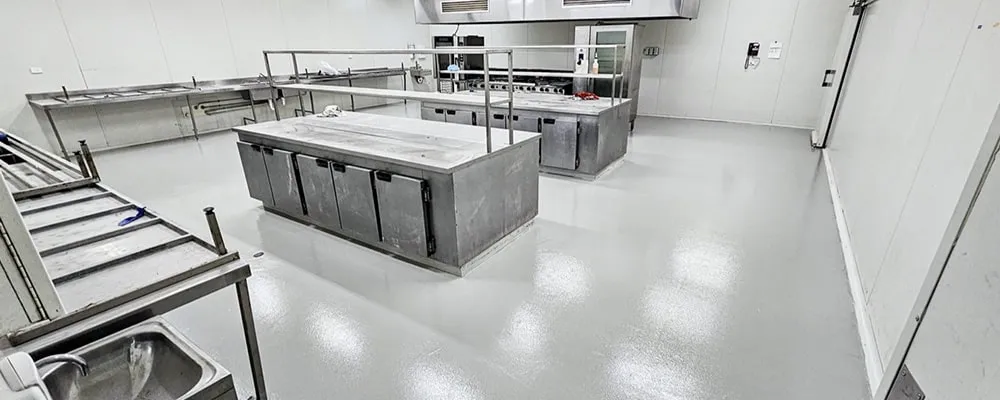
Commercial Kitchen Flooring in Pakistan: Best Flooring Systems, Cost, Installation & Maintenance
Commercial kitchen flooring must withstand heavy foot traffic, hot water, grease, food spills, cleaning chemicals, impact and frequent washing. Unlike ordinary flooring, a professional kitchen floor needs to provide durability, hygiene, slip resistance and easy maintenance while remaining suitable for demanding food-service environments.
Restaurants, hotels, bakeries, hospitals, catering facilities, food-processing areas and institutional kitchens require flooring systems designed for wet and chemically demanding conditions. Epoxy, polyurethane cement and other industrial flooring systems can be specified according to the kitchen’s operating requirements.
The flooring should be treated as part of the kitchen’s hygiene and safety system rather than simply as a decorative finish. Proper concrete preparation, drainage, coving, slope and installation are just as important as selecting the flooring material.
What Is Commercial Kitchen Flooring?
Commercial kitchen flooring is a heavy-duty flooring system designed for professional food-preparation and cooking environments. It is commonly used in restaurants, hotels, bakeries, cafeterias, hospitals, food factories and catering kitchens.
These environments experience conditions that can quickly damage ordinary concrete, ceramic tiles and low-grade coatings. Water, oil, grease, food products, cleaning chemicals, dropped equipment and continuous traffic can create demanding conditions for the floor.
A properly specified commercial kitchen floor should provide a combination of chemical resistance, slip resistance, moisture tolerance, mechanical strength, hygiene and easy cleaning.
Why Is Specialized Kitchen Flooring Important?
Hygiene
Seamless flooring reduces joints and gaps where food debris, grease and contaminants can accumulate.
Slip Resistance
Properly textured flooring can improve traction in wet and greasy working conditions.
Chemical Resistance
Industrial resin systems can be selected to withstand common cleaning agents and kitchen chemicals.
Heavy-Duty Performance
Commercial kitchens require floors capable of handling continuous traffic, carts, equipment and impacts.
Best Flooring Options for Commercial Kitchens
Several flooring systems can be used in commercial kitchens. The correct choice depends on temperature exposure, moisture, cleaning chemicals, traffic and the condition of the existing substrate.
1. Heavy-Duty Epoxy Flooring
Epoxy flooring is a popular option for commercial and industrial kitchen areas because it can provide a seamless, durable and chemically resistant surface.
- Seamless finish.
- Good chemical resistance.
- Easy routine cleaning.
- High abrasion resistance.
- Available in different thicknesses.
- Can incorporate anti-slip aggregates.
- Available in multiple colours.
Best for: Restaurants, cafeterias, commercial kitchens, storage areas and food-service facilities where temperatures are controlled and heavy-duty chemical and mechanical resistance are required.
2. Polyurethane Cement Flooring
Polyurethane cement, also known as PU cement flooring, is designed for demanding industrial environments where floors may experience moisture, thermal shock, chemicals and heavy traffic.
- High mechanical strength.
- Excellent resistance to demanding environments.
- Suitable for wet processing areas.
- Can provide textured anti-slip finishes.
- Suitable for heavy-duty food environments.
- Good resistance to thermal and chemical exposure when properly specified.
Best for: Large commercial kitchens, food-processing areas, industrial kitchens and facilities with severe wet or thermal exposure.
3. Epoxy Screed Flooring
Epoxy screed systems provide a thicker and more robust resin flooring solution for areas subjected to heavy traffic, impact and demanding operating conditions.
- High build thickness.
- Excellent mechanical performance.
- Suitable for heavy-duty applications.
- Can be textured for improved traction.
- Suitable for industrial kitchen environments.
Best for: High-traffic kitchens, industrial food facilities and areas requiring a more robust floor build-up.
4. Anti-Slip Epoxy Flooring
Anti-slip epoxy systems incorporate suitable aggregates or textured finishes to improve traction in wet and contaminated areas.
- Improved wet-area traction.
- Seamless resin surface.
- Easy to clean when correctly textured.
- Can be customized for different operating conditions.
- Suitable for food-service environments.
Best for: Washing areas, cooking zones, dishwashing areas and other locations where water or grease can reach the floor.
5. Industrial Tile Flooring
Heavy-duty tiles can be used in certain commercial kitchen environments, particularly where a tiled system is already established.
However, joints and grout lines can require more intensive cleaning and maintenance compared with a properly installed seamless resin floor.
Commercial Kitchen Flooring Comparison
| Flooring System | Durability | Slip Resistance | Chemical Resistance | Typical Application |
|---|---|---|---|---|
| Heavy-Duty Epoxy | High | Good to Excellent | Excellent | Restaurants and commercial kitchens |
| PU Cement | Excellent | Excellent | Excellent | Heavy-duty food processing |
| Epoxy Screed | Excellent | Excellent | Excellent | Heavy industrial kitchen areas |
| Anti-Slip Epoxy | High | Excellent | High | Wet and greasy areas |
| Industrial Tiles | High | Good | Good | Selected commercial kitchens |
Key Requirements of Commercial Kitchen Flooring
Seamless Surface
Seamless flooring minimizes joints and makes routine cleaning easier compared with floors containing numerous grout lines.
Anti-Slip Performance
The floor should provide suitable traction for workers operating in areas where water, grease or food liquids may be present.
Chemical Resistance
Flooring should be compatible with the detergents, degreasers and cleaning chemicals used at the facility.
Water Resistance
Wet cleaning and frequent washing require an appropriately designed flooring system and substrate.
Impact Resistance
Floors may be exposed to dropped utensils, containers, equipment and heavy carts.
Thermal Resistance
Areas exposed to hot water, steam or temperature changes may require a flooring system specifically designed for thermal stress.
Anti-Slip Commercial Kitchen Flooring
Slip resistance is one of the most important considerations when selecting flooring for a commercial kitchen. Water, cooking oil, grease and food products can significantly increase the risk of slipping on smooth surfaces.
Anti-slip resin floors can incorporate selected aggregates or textured finishes to provide additional traction. The texture should be carefully selected because excessively rough flooring may become harder to clean.
Epoxy Flooring for Restaurant Kitchens
Restaurants require flooring that can withstand daily cooking, washing, food spills, employee traffic, trolley movement and frequent cleaning.
Epoxy flooring can provide a practical seamless surface for many restaurant kitchens when the correct resin system, thickness, surface texture and substrate preparation are selected.
- Easy routine cleaning.
- Seamless finish.
- Good resistance to grease and many chemicals.
- Suitable for high-traffic environments.
- Customizable colours.
- Anti-slip aggregate options.
- Can be integrated with coved skirting.
Commercial Kitchen Flooring for Hotels
Hotel kitchens can experience significantly higher traffic than smaller restaurants. Large quantities of food are prepared daily, while staff, carts, containers and equipment move continuously through preparation, cooking, washing and storage areas.
Hotel kitchen flooring should therefore be selected according to each zone. Cooking areas, dishwashing zones, cold rooms, food preparation areas and service corridors may require different levels of chemical, thermal and slip resistance.
Commercial Kitchen Flooring for Hospitals
Hospital kitchens require flooring systems that support hygiene, regular cleaning and heavy operational use. Food preparation and washing areas can be exposed to water, cleaning chemicals and continuous staff traffic.
Seamless resin flooring can be considered where easy cleaning, durability and reduced jointing are important. The flooring specification should be coordinated with the facility’s hygiene procedures and applicable regulations.
Food Processing and Industrial Kitchen Flooring
Food-processing facilities can have more severe flooring requirements than standard commercial kitchens. Floors may be exposed to hot liquids, steam, aggressive cleaning, heavy equipment, chemicals and repeated impact.
In these conditions, polyurethane cement or heavy-duty resin screed systems may be more appropriate than a standard thin epoxy coating. The flooring thickness and resin chemistry should be selected based on the actual service conditions.
Commercial Kitchen Floor Drainage and Slope
Drainage is an important part of kitchen floor design. Commercial kitchens are frequently washed and may generate significant quantities of water.
The floor should be designed so water can move toward suitable drains rather than collecting in low spots. Drain locations, channel drains, floor gradients and transitions should be planned before the final flooring installation.
Correct Floor Slope
Appropriate falls help direct water toward drainage points and reduce standing water.
Drain Integration
Drains should be properly integrated with the flooring system to minimize weak points and water penetration.
Easy Cleaning
Proper drainage supports efficient washing and cleaning of the kitchen floor.
Hygienic Detailing
Floor-to-wall transitions and drainage details should be designed to minimize difficult-to-clean areas.
Epoxy Flooring Coving for Commercial Kitchens
The floor-to-wall junction is an important detail in commercial kitchens. A resin cove can create a continuous transition between the floor and wall, reducing sharp corners and making cleaning easier.
Coving can also help protect wall bases from water, cleaning activities and mechanical impacts. The exact cove height should be selected according to the kitchen design and hygiene requirements.
Commercial Kitchen Flooring Installation Process
- Site Inspection: Assess the kitchen layout, operating conditions, existing floor and drainage requirements.
- Substrate Assessment: Check concrete strength, moisture, cracks, contamination and surface condition.
- Surface Preparation: Mechanically prepare the concrete to remove laitance, grease, weak material and contaminants.
- Crack and Joint Treatment: Repair suitable defects and detail joints according to the flooring system.
- Moisture Management: Test the substrate and apply an appropriate moisture-control system when necessary.
- Primer: Apply the compatible primer to promote adhesion.
- Base / Screed Layer: Install the specified body coat or heavy-duty screed.
- Anti-Slip Finish: Broadcast or incorporate the selected aggregate where required.
- Topcoat: Apply the compatible protective finish.
- Coving: Install resin coving where specified.
- Curing: Allow the complete system to cure according to the manufacturer’s requirements.
- Final Inspection: Check the surface for uniformity, adhesion, texture, drainage and finishing quality.
Concrete Preparation for Commercial Kitchen Flooring
Poor preparation is one of the most common reasons for premature failure of resin flooring. Kitchen floors can contain oil, grease, moisture and other contaminants that must be removed before installation.
- Remove grease, oil and contaminants.
- Mechanically prepare the concrete.
- Remove weak or unsound material.
- Repair cracks and damaged areas.
- Check concrete strength and condition.
- Test moisture before coating.
- Verify the required floor levels and drainage slope.
- Ensure the surface is clean before primer application.
Commercial Kitchen Flooring Thickness
Flooring thickness should be selected according to traffic, impact, chemical exposure, thermal conditions and substrate requirements. A thin decorative epoxy coating is not equivalent to a heavy-duty industrial resin screed.
| System Type | Typical Use | Performance Level |
|---|---|---|
| Thin Epoxy Coating | Light-duty areas | Basic |
| Self-Leveling Epoxy | Commercial kitchen and service areas | Medium–High |
| Heavy-Duty Epoxy | High-traffic kitchen areas | High |
| Epoxy Screed | Severe mechanical exposure | Very High |
| PU Cement | Severe wet, thermal and industrial conditions | Very High |
Exact thickness should be specified by the flooring contractor or system manufacturer based on the actual operating conditions.
Commercial Kitchen Flooring Price in Pakistan
The commercial kitchen flooring price in Pakistan depends on the flooring system, thickness, floor area, substrate condition, drainage requirements, coving, anti-slip finish and installation location.
| Flooring Option | Relative Cost | Suitable Application |
|---|---|---|
| Standard Epoxy Coating | Low–Medium | Light commercial areas |
| Self-Leveling Epoxy | Medium | Commercial kitchen areas |
| Heavy-Duty Epoxy | Medium–High | High-traffic kitchens |
| Epoxy Screed | High | Heavy-duty industrial applications |
| PU Cement Flooring | High | Severe food-processing environments |
Factors That Affect Commercial Kitchen Flooring Cost
Floor Area
Larger projects require more material but may benefit from improved installation efficiency.
Existing Floor Condition
Cracks, contamination, unevenness and damaged concrete can increase preparation costs.
System Thickness
Heavy-duty systems require more resin and aggregate than thin protective coatings.
Anti-Slip Finish
Specialized aggregate broadcasting and textured finishing can increase installation requirements.
Coving
Resin coving requires additional material and skilled detailing at floor-to-wall junctions.
Drainage
New drains, channel drains or floor-level corrections can add significant project costs.
Commercial Kitchen Flooring Maintenance
Even a heavy-duty floor requires regular cleaning and inspection. A maintenance program should be based on the type of kitchen, traffic level and chemicals used during cleaning.
Daily Cleaning
- Remove food debris promptly.
- Clean oil and grease spills.
- Wash the floor using approved cleaners.
- Keep drainage channels clear.
Regular Inspection
- Check for cracks or chips.
- Inspect high-traffic areas.
- Check coving and wall transitions.
- Inspect around drains and equipment.
Chemical Management
- Use compatible cleaning chemicals.
- Follow recommended dilution ratios.
- Avoid unnecessary exposure to aggressive chemicals.
- Rinse residues where required.
Repair
- Repair damaged areas promptly.
- Address substrate movement.
- Replace severely damaged sections when necessary.
- Maintain drainage and floor falls.
Common Commercial Kitchen Flooring Problems
Peeling or Delamination
Poor preparation, contamination or moisture can contribute to loss of adhesion.
Cracking
Substrate movement or untreated cracks can eventually transfer into the flooring system.
Slippery Surface
Smooth finishes may become hazardous when contaminated with water, grease or oil.
Standing Water
Poor drainage or incorrect floor falls can leave water standing in low areas.
Surface Wear
Incorrect system selection can lead to premature wear in high-traffic areas.
Thermal Damage
Flooring not designed for severe thermal exposure can deteriorate when subjected to rapid temperature changes.
How to Choose the Best Commercial Kitchen Flooring
- Identify the Operating Conditions: Determine exposure to water, grease, oil, chemicals, heat, steam and heavy traffic.
- Inspect the Concrete: Check moisture, cracks, strength, contamination and surface condition.
- Choose the Correct Resin System: Select epoxy, epoxy screed or PU cement according to the actual service conditions.
- Select Slip Resistance: Specify a suitable texture for wet and greasy areas.
- Plan Drainage: Ensure water can move toward suitable drains.
- Consider Coving: Use hygienic floor-to-wall detailing where required.
- Specify the Correct Thickness: Match the system thickness to traffic, impact and chemical exposure.
- Use Professional Installation: Correct preparation and installation are essential to long-term performance.
Commercial Kitchen Flooring Applications
Restaurant Kitchens
Heavy-duty seamless floors for cooking and food preparation areas.
Hotel Kitchens
Durable flooring for high-volume food production and service operations.
Bakery Floors
Flooring for areas exposed to flour, food ingredients, traffic and frequent cleaning.
Hospital Kitchens
Hygienic flooring designed for regular cleaning and institutional food-service operations.
Catering Facilities
Heavy-duty surfaces for high-volume preparation and commercial food production.
Food Processing Plants
Industrial resin flooring for demanding wet and chemical processing environments.
Commercial Kitchen Flooring in Pakistan
Commercial kitchen flooring can be installed in restaurants, hotels, hospitals, bakeries, food factories and catering facilities throughout Pakistan.
Lahore
Epoxy, PU cement and anti-slip flooring solutions for restaurants, hotels and industrial kitchens.
Karachi
Flooring specifications can be adapted for humid coastal conditions and heavy commercial kitchen use.
Islamabad & Rawalpindi
Commercial kitchen flooring for hotels, restaurants, hospitals and institutional facilities.
Faisalabad & Gujranwala
Industrial and commercial resin flooring for food-service and processing facilities.
Multan & Bahawalpur
Heavy-duty kitchen floors can be selected according to heat, traffic and cleaning requirements.
Other Cities
Flooring systems can be specified according to local climate, site conditions and kitchen operating requirements.
Commercial Kitchen Flooring Project Checklist
- Assess the existing concrete substrate.
- Check moisture levels.
- Identify grease and oil contamination.
- Inspect cracks and joints.
- Confirm drainage requirements.
- Determine required anti-slip performance.
- Identify chemical exposure.
- Identify hot water and thermal exposure.
- Select the correct resin chemistry.
- Specify appropriate flooring thickness.
- Plan floor-to-wall coving.
- Coordinate floor drains and channels.
- Establish cleaning procedures.
- Request technical specifications and warranty details.
Frequently Asked Questions
What is the best flooring for a commercial kitchen?
Heavy-duty epoxy and polyurethane cement flooring are common choices. The best system depends on the kitchen’s exposure to water, grease, chemicals, impact, heat and cleaning.
Is epoxy flooring suitable for commercial kitchens?
Yes. Properly specified epoxy flooring can provide a seamless, durable and chemically resistant surface suitable for many commercial kitchens.
Is epoxy flooring slip resistant for kitchens?
Epoxy can be made more slip resistant by incorporating suitable aggregates or textured finishes. The texture should be selected according to the actual wet and greasy conditions of the kitchen.
What is PU cement flooring?
PU cement is a heavy-duty polyurethane-based flooring system designed for demanding industrial environments. It can be specified where moisture, chemicals, heavy traffic and thermal exposure require a more robust system.
What is the difference between epoxy and PU cement flooring?
Standard epoxy is widely used for durable seamless flooring, while PU cement is generally selected for more severe industrial conditions involving moisture, thermal shock, heavy impact and demanding cleaning regimes.
Can epoxy flooring withstand hot water?
The answer depends on the specific epoxy system and exposure conditions. Areas subject to repeated hot-water or severe thermal exposure may require a specially formulated system such as PU cement.
Does commercial kitchen flooring need to be waterproof?
Kitchen floors are frequently exposed to water, so the flooring system and substrate should be designed to manage wet cleaning and moisture. Drainage and substrate preparation are also essential.
Why is floor slope important in a commercial kitchen?
Proper floor slope helps direct wash water toward drains and reduces standing water. The required slope should be planned according to the kitchen layout and drainage design.
What is epoxy coving in a commercial kitchen?
Epoxy coving is a resin detail that creates a curved or continuous transition between the floor and wall. It can make the junction easier to clean and protect the lower wall area.
How much does commercial kitchen flooring cost in Pakistan?
Cost depends on the flooring system, thickness, floor area, substrate condition, anti-slip requirements, coving, drainage and installation location. A site assessment is recommended for an accurate quotation.
How long does commercial kitchen epoxy flooring last?
Service life depends on the resin system, thickness, substrate, traffic, chemical exposure, cleaning practices and installation quality. A correctly specified heavy-duty system can provide long-term performance under commercial use.
Can commercial kitchen flooring be installed over existing concrete?
Yes, provided the existing concrete is structurally sound and can be properly prepared. Moisture, contamination, cracks, unevenness and other defects should be addressed before installation.
How do you clean epoxy commercial kitchen floors?
Remove food debris and grease regularly, use a compatible commercial floor cleaner and follow the flooring manufacturer’s cleaning recommendations. Avoid unsuitable chemicals or cleaning methods that may damage the finish.
Need Commercial Kitchen Flooring in Pakistan?
Get a heavy-duty flooring solution designed for your kitchen’s traffic, moisture, grease, chemical, cleaning and thermal requirements.
Request a Commercial Kitchen Flooring QuoteRelated Flooring Services
Conclusion
Commercial kitchen flooring must be selected according to the actual conditions of the facility. Water, grease, chemicals, heavy traffic, impact, cleaning and heat can quickly expose weaknesses in an unsuitable flooring system.
Heavy-duty epoxy, epoxy screed and polyurethane cement flooring can provide durable solutions for different kitchen environments. Anti-slip textures, proper drainage, hygienic coving and correct substrate preparation are equally important components of a successful installation.
The most reliable approach is to inspect the existing floor, identify the operating conditions and specify a complete flooring system rather than choosing a coating based only on its appearance or initial price.