
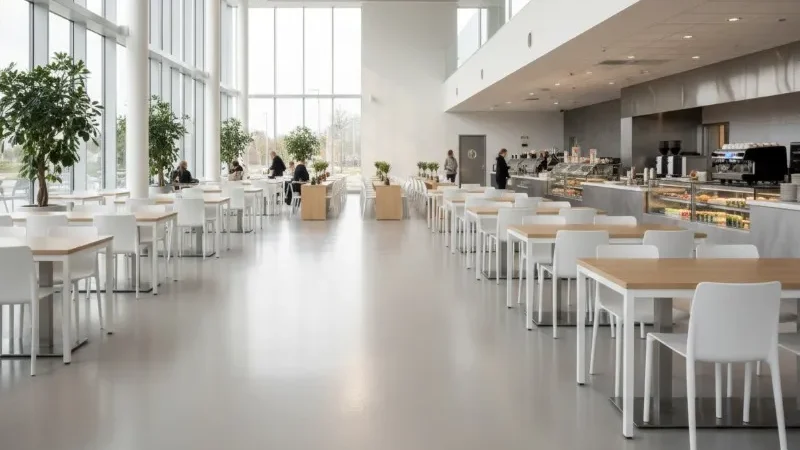
Restaurant Epoxy Flooring in Pakistan: Hygiene, Durability, Safety & Cost Guide
Discover how restaurant epoxy flooring creates a seamless, hygienic, slip-resistant and durable surface for commercial kitchens, dining areas, cafés, bakeries, fast-food outlets and food-service facilities across Pakistan.
Restaurant flooring experiences conditions that ordinary residential floors rarely encounter. Commercial kitchens deal with grease, hot liquids, water, steam, food spills, cleaning chemicals, heavy equipment and continuous staff movement.
At the same time, restaurant dining areas require an attractive floor that can withstand customer traffic, chair movement and frequent cleaning.
Epoxy flooring provides a practical solution by creating a continuous, non-porous surface that can be customised for different restaurant zones. Anti-slip systems can be used in kitchens, while decorative finishes can be selected for dining areas and customer-facing spaces.
Why Restaurants Need High-Performance Flooring
A restaurant floor must perform as part of the overall hygiene and safety system. It needs to withstand daily cleaning while remaining safe for employees and customers.
Grease & Oil Exposure
Commercial kitchens generate grease and cooking oils that can contaminate conventional floors and grout lines.
Constant Moisture
Water, steam, spills and frequent washing make restaurant kitchens continuously exposed to moisture.
Slip Risk
Wet and greasy floors can become dangerous. Anti-slip epoxy systems provide additional grip where required.
Heavy Traffic
Kitchen staff, customers, trolleys and equipment place continuous mechanical demands on restaurant flooring.
Benefits of Restaurant Epoxy Flooring
Seamless Surface
Epoxy creates a continuous floor surface without traditional tile grout joints where dirt and moisture can accumulate.
Easy Cleaning
The smooth, properly cured surface can make routine sweeping, mopping and mechanical cleaning easier.
Grease Resistance
A correctly selected epoxy system can resist common cooking oils and grease contamination.
Chemical Resistance
Suitable formulations can provide resistance to cleaning chemicals, degreasers and disinfectants.
Slip Resistance
Aggregate broadcast systems can provide a textured surface for improved traction in wet kitchen environments.
Durability
Commercial-grade epoxy systems can withstand heavy pedestrian traffic and demanding restaurant operations.
Moisture Resistance
A properly installed epoxy system provides a continuous protective surface over suitable concrete substrates.
Decorative Flexibility
Dining areas can use colours, metallic effects, flakes and other decorative finishes to match the restaurant’s design.
Restaurant Epoxy Flooring: Zone-by-Zone Guide
A restaurant is made up of several different operating zones. The flooring specification should be selected according to the exposure, traffic and hygiene requirements of each area.
Commercial Kitchen
Kitchens require heavy-duty, chemical-resistant and slip-resistant flooring capable of handling grease, water, cleaning chemicals and heavy equipment.
Dining Area
Dining spaces can use decorative self-leveling, metallic, flake or solid-colour epoxy finishes for an attractive customer-facing environment.
Service Corridors
Service routes need durable, easy-to-clean flooring with appropriate slip resistance for staff moving between kitchen and dining areas.
Cold Rooms
Cold storage areas require systems capable of handling temperature changes and condensation.
Washrooms
Restaurant washrooms benefit from non-porous and slip-resistant surfaces that can withstand frequent cleaning.
Cafés & Bakeries
Decorative epoxy can provide a modern seamless appearance while supporting the hygiene and cleaning requirements of food-service spaces.
Commercial Kitchen Epoxy Flooring
The commercial kitchen is usually the most demanding area of a restaurant. Flooring must handle grease, water, cleaning chemicals, heavy equipment and continuous staff traffic.
A heavy-duty epoxy system with an anti-slip aggregate broadcast is often suitable for kitchen environments where wet-floor traction is important.
Recommended Kitchen Features
- Heavy-duty epoxy or resin flooring system.
- Suitable anti-slip aggregate broadcast.
- Resistance to grease and cooking oils.
- Resistance to common cleaning chemicals.
- Appropriate resistance to hot water and thermal exposure.
- Seamless and easy-to-clean surface.
- Coved floor-to-wall detailing where hygiene requirements demand it.
- Properly prepared concrete substrate.
Epoxy Coving for Restaurant Kitchens
The floor-to-wall junction is an important detail in commercial food preparation areas. Traditional right-angle junctions can create difficult-to-clean edges where water, grease and food particles may accumulate.
Epoxy coving creates a curved transition between the floor and wall. This can make cleaning and sanitisation easier and provides a more continuous hygienic finish.
Improved Cleanability
The curved transition makes it easier to clean the floor directly against the wall.
Reduced Dirt Traps
Coved details minimise sharp floor-wall corners where grease, moisture and food debris can accumulate.
Seamless Appearance
The floor and cove can be finished as one continuous resin system.
Hygiene-Focused Design
Coving is particularly useful in kitchens and food preparation areas where frequent cleaning is required.
Decorative Epoxy Flooring for Restaurant Dining Areas
Dining areas have different requirements from commercial kitchens. Here the flooring needs to combine durability and easy maintenance with an attractive appearance.
Metallic Epoxy
Creates unique flowing patterns and a premium decorative appearance suitable for upscale restaurants and cafés.
Solid Colour Epoxy
Provides a clean, uniform floor that can be coordinated with restaurant branding and interior colours.
Flake Epoxy
Decorative flakes add visual variation and can provide a practical finish for commercial dining environments.
Custom Graphics
Selected resin systems can incorporate logos, patterns and other decorative elements.
Types of Epoxy Flooring for Restaurants
Self-Leveling Epoxy
Provides a smooth, uniform finish over a properly prepared substrate and is suitable for selected kitchen and dining applications.
Broadcast Anti-Slip Epoxy
Uses aggregate broadcast into the resin system to provide additional traction in wet and greasy areas.
Heavy-Duty Epoxy
Designed for demanding areas exposed to equipment, trolleys, heavy traffic and mechanical loads.
Metallic Epoxy
A decorative system suitable for dining areas, cafés and premium restaurant interiors.
Epoxy Flake Flooring
Combines resin flooring with decorative flakes to create a durable and visually varied finish.
Polyurethane-Modified Topcoat
A compatible PU-modified protective layer may be selected where additional abrasion, chemical or UV performance is required.
Recommended Restaurant Epoxy Flooring Thickness
Flooring thickness should be selected according to the traffic, exposure and intended use of each restaurant zone.
| Restaurant Area | Typical System | Indicative Thickness |
|---|---|---|
| Dining Area | Decorative / Self-Leveling Epoxy | 1.5–2.5 mm |
| Service Corridor | Anti-Slip Self-Leveling Epoxy | 2–3 mm |
| Commercial Kitchen | Broadcast Anti-Slip Epoxy | 3–4 mm+ |
| Heavy-Duty Kitchen Zone | Heavy-Duty Resin System | 3–6 mm+ |
| Washroom | Anti-Slip Epoxy | 2–3 mm |
These values are indicative rather than universal specifications. Actual thickness should be determined after evaluating the concrete substrate, traffic, equipment loads, thermal exposure and chemical requirements.
Heat, Grease & Chemical Resistance
Restaurant floors can be exposed to a wide range of contaminants. The selected flooring system should be matched to the actual operating conditions.
Cooking Oil
Suitable epoxy formulations can provide resistance to routine exposure to cooking oils and grease.
Cleaning Chemicals
Chemical-resistant formulations can be selected for areas exposed to commercial cleaning agents.
Hot Water
Commercial-grade systems can be selected for environments exposed to hot water and cleaning operations.
Food Spills
The seamless surface helps simplify removal of many common food and beverage spills.
Restaurant Epoxy Flooring Installation Process
Proper installation is critical to the performance of restaurant epoxy flooring. The system should be installed over a clean, mechanically prepared and suitably dry substrate.
Site Inspection
Inspect the concrete for cracks, contamination, moisture, weak areas and existing coatings.
Cleaning
Remove grease, oil, dirt and other contaminants before mechanical preparation.
Mechanical Grinding
Diamond grinding, shot blasting or another suitable preparation method creates the required surface profile.
Crack & Joint Repair
Appropriate repair materials are used to address cracks, holes and damaged areas.
Moisture Assessment
The concrete is assessed for moisture conditions before resin flooring installation.
Primer Application
A compatible primer is applied to improve adhesion between the concrete and resin flooring system.
Epoxy Base Coat
The selected epoxy system is installed at the specified thickness.
Anti-Slip Aggregate
Suitable aggregate is broadcast into the wet coating in kitchen and other slip-sensitive areas.
Topcoat
A compatible protective topcoat is applied according to the system requirements.
Curing
The floor remains protected from traffic until the required curing period has been completed.
How Long Does Restaurant Epoxy Flooring Take to Install?
Installation time depends on floor area, substrate condition, number of coats, decorative requirements and curing conditions.
| Project | Indicative Installation Period |
|---|---|
| Small Kitchen | Approximately 3–5 days |
| Kitchen + Dining Area | Approximately 4–7 days |
| Large Restaurant | Approximately 5–10+ days |
These are planning estimates only. The floor should not be returned to full restaurant operations until the selected system has achieved the required cure.
Restaurant Epoxy Flooring Price in Pakistan
Restaurant epoxy flooring cost in Pakistan depends on the flooring system, floor area, substrate condition, required thickness, anti-slip aggregate, decorative finish and project location.
| Restaurant Area / System | Indicative Price Per Sq. Ft. |
|---|---|
| Standard Kitchen Epoxy | PKR 450–700+ |
| Commercial Kitchen Anti-Slip Epoxy | PKR 600–950+ |
| Dining Area Solid Colour Epoxy | PKR 400–600+ |
| Decorative / Flake Epoxy | PKR 500–850+ |
| Metallic Epoxy | PKR 900–1,500+ |
| Washroom Anti-Slip Epoxy | PKR 550–850+ |
| Specialist Cold-Room Flooring | PKR 700–1,100+ |
Factors That Affect Restaurant Epoxy Flooring Cost
Floor Size
Larger projects can have different material and labour economics than small restaurant installations.
Concrete Condition
Cracks, damaged concrete, grease contamination and old coatings can increase preparation costs.
Floor Thickness
Heavy-duty systems require more material and typically cost more than thin decorative coatings.
Anti-Slip Finish
Aggregate broadcast systems require additional materials and application steps.
Decorative Finish
Metallic effects, flakes, graphics and custom designs can increase the overall project cost.
Coving
Kitchen coving requires additional detailing and material compared with a standard floor termination.
Restaurant Epoxy Flooring Applications
Commercial Kitchens
Heavy-duty, hygienic and anti-slip systems for food preparation areas.
Fine Dining Restaurants
Premium decorative finishes for high-end customer-facing interiors.
Fast Food Outlets
Durable and easy-to-clean systems for high-turnover food-service environments.
Bakeries
Seamless flooring for food preparation and customer areas.
Cafés
Decorative epoxy can provide a modern appearance while supporting everyday cleaning requirements.
Hotel Kitchens
High-performance systems can be specified for demanding hospitality and food-preparation operations.
Food Courts
Durable commercial flooring for areas exposed to heavy customer and service traffic.
Cloud Kitchens
Practical seamless flooring for delivery-focused commercial food preparation facilities.
Best Epoxy Flooring for Different Restaurant Formats
Fine Dining Restaurants
Fine dining spaces can benefit from metallic epoxy, premium solid colours or other decorative resin systems. The floor can be matched to lighting, furniture and the restaurant’s visual identity.
Fast Food & QSR Restaurants
Fast-food outlets generally prioritise durability, rapid cleaning, slip resistance and consistent branding. A medium-build epoxy system with an appropriate topcoat can be a practical choice.
Hotel Kitchens
Hotel kitchens typically have high traffic and demanding cleaning requirements. Heavy-duty resin flooring systems with appropriate anti-slip characteristics can be specified for these environments.
Cafés & Bakeries
Cafés and bakeries can combine hygiene-focused flooring with decorative finishes. Flake, solid-colour and metallic epoxy systems can all be considered depending on the desired appearance.
How to Maintain Restaurant Epoxy Flooring
Regular maintenance is essential for preserving both the hygiene performance and appearance of epoxy restaurant flooring.
- Remove food particles and loose dirt regularly.
- Clean grease and oil spills as soon as practical.
- Use a compatible commercial floor cleaner or degreaser.
- Follow the manufacturer’s recommended dilution ratio.
- Avoid prolonged exposure to concentrated chemicals.
- Use suitable cleaning pads that will not unnecessarily damage the topcoat.
- Use floor protection under furniture and equipment where appropriate.
- Inspect high-traffic areas periodically for wear or damage.
- Repair damaged areas before deterioration spreads.
Restaurant Epoxy Flooring vs Tile Flooring
| Feature | Epoxy Flooring | Traditional Tiles |
|---|---|---|
| Surface | Seamless | Multiple tile joints |
| Grout | No traditional grout | Requires grout maintenance |
| Cleaning | Generally easy to clean | Grout lines require additional attention |
| Slip Resistance | Can be designed with aggregate texture | Depends on tile finish and texture |
| Decorative Options | Colours, metallics, flakes and graphics | Depends on available tile designs |
| Joint Maintenance | No conventional grout joints | Grout can stain or deteriorate |
| Repair | Resin repair or recoating may be possible | Individual tiles can be replaced |
Restaurant Epoxy Flooring in Pakistan’s Climate
Restaurant flooring in Pakistan must be installed with consideration for temperature, humidity and moisture conditions. These factors can affect epoxy application and curing.
Hot Weather
High temperatures can shorten the working time of mixed epoxy. Application should follow the manufacturer’s temperature requirements.
Humidity
High humidity and condensation should be controlled during installation to minimise surface and adhesion problems.
Monsoon Conditions
Moisture in concrete should be carefully assessed during periods of heavy rain and high humidity.
Kitchen Heat
Areas close to fryers, ovens and tandoors may require specialist heat-resistant flooring.
Common Restaurant Epoxy Flooring Mistakes
Skipping Surface Preparation
Applying epoxy over grease, dust, weak concrete or contamination can cause adhesion failure.
Ignoring Moisture
Excessive substrate moisture can contribute to blistering, debonding and other flooring problems.
No Anti-Slip Protection
Smooth epoxy can become slippery when wet, making aggregate texture important in kitchen areas.
Using the Wrong Chemical Resistance
Flooring should be selected according to the actual cleaning chemicals and contaminants used at the restaurant.
Insufficient Thickness
A thin coating may not be suitable for heavy equipment, trolleys or demanding kitchen traffic.
Opening Too Early
Allowing full restaurant operations before sufficient curing can damage the new flooring system.
Frequently Asked Questions About Restaurant Epoxy Flooring
What is restaurant epoxy flooring?
Restaurant epoxy flooring is a resin-based flooring system designed for commercial food-service areas. It creates a seamless surface that can be specified for hygiene, durability, chemical resistance and slip resistance.
Is epoxy flooring suitable for commercial kitchens?
Yes. Properly specified commercial epoxy systems are widely used for demanding kitchen environments. Kitchen systems should be selected for grease, chemical, moisture, traffic and slip-resistance requirements.
Is epoxy flooring safe for restaurant kitchens?
A properly installed and appropriately specified epoxy system can provide a hygienic and durable kitchen floor. Material suitability and any required food-service documentation should be confirmed for the specific application.
Is restaurant epoxy flooring slippery?
Smooth epoxy can be slippery when wet. For commercial kitchens, an appropriate anti-slip aggregate broadcast or textured topcoat should be incorporated according to the site’s conditions.
How much does restaurant epoxy flooring cost in Pakistan?
Indicative restaurant epoxy flooring prices can range from approximately PKR 400 to PKR 1,500+ per square foot depending on the area, system, thickness, preparation and decorative finish.
How thick should restaurant kitchen epoxy flooring be?
Commercial kitchen systems are commonly specified at around 3–4 mm or more depending on traffic, equipment loads, thermal exposure and the selected resin system.
Can epoxy flooring resist cooking oil and grease?
Suitable commercial epoxy formulations can provide good resistance to cooking oils and grease. Spills should still be cleaned promptly using compatible cleaning products.
Can epoxy flooring withstand hot kitchen temperatures?
Epoxy systems have different temperature ratings. Areas exposed to direct or continuous high heat near fryers, ovens and tandoors may require specialist heat-resistant resin flooring.
Can restaurant epoxy flooring be used in dining areas?
Yes. Dining areas can use solid-colour, metallic, flake or other decorative epoxy finishes designed for commercial pedestrian traffic.
Can epoxy flooring be used in restaurant washrooms?
Yes. Anti-slip epoxy systems can be used in restaurant washrooms where moisture resistance, cleanability and slip resistance are important.
Does restaurant epoxy flooring require concrete preparation?
Yes. Proper cleaning, mechanical preparation, crack repair and moisture assessment are essential for reliable epoxy adhesion and long-term performance.
How long does restaurant epoxy flooring take to install?
A small to medium restaurant project may take approximately 3–7 days depending on preparation, system layers and floor area. Full curing can require additional time before heavy restaurant operations resume.
Can restaurant epoxy flooring have a decorative finish?
Yes. Metallic epoxy, decorative flakes, solid colours and selected custom graphic effects can be used in dining areas and customer-facing spaces.
Is epoxy flooring better than tiles for restaurant kitchens?
Epoxy provides a seamless surface without conventional grout joints and can be designed for slip resistance, chemical resistance and easy cleaning. Tiles have their own advantages, so the best option depends on the restaurant’s specific requirements and substrate.
Need Restaurant Epoxy Flooring in Pakistan?
Get professional guidance for commercial kitchen flooring, anti-slip epoxy, dining-area finishes, epoxy coving, surface preparation and project pricing.
Request a Restaurant Flooring ConsultationRelated Epoxy Flooring Guides
Conclusion
Restaurant epoxy flooring offers a combination of hygiene, durability, cleanability and design flexibility that makes it suitable for many food-service environments in Pakistan.
Commercial kitchens can benefit from heavy-duty anti-slip systems, while dining areas can use decorative epoxy finishes to create a modern and memorable customer environment.
The most important part of a successful restaurant flooring project is selecting the correct system for each zone. Kitchen floors, dining areas, service corridors, washrooms and cold rooms can have significantly different performance requirements.
With proper concrete preparation, correct material selection, appropriate anti-slip detailing and professional installation, restaurant epoxy flooring can provide a durable and easy-to-maintain foundation for demanding food-service operations.