
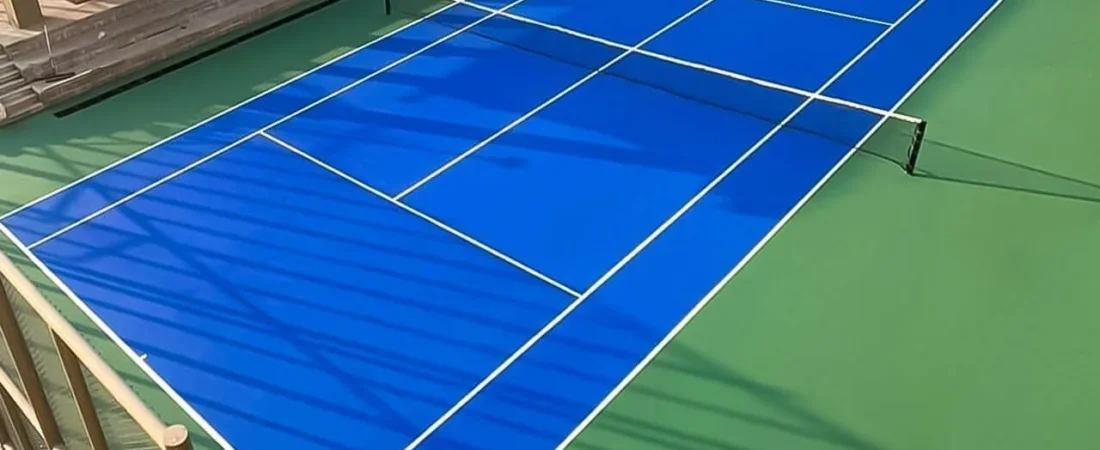
Tennis Court Flooring Options in Pakistan: Acrylic, Turf, Clay & Modular Tiles
Choosing the right tennis court flooring in Pakistan affects ball bounce, court speed, player traction, comfort, durability and long-term maintenance. From outdoor acrylic hard courts to clay, synthetic turf and modular interlocking tiles, each surface has its own advantages and limitations.
In Pakistan’s climate, the best tennis court surface depends on whether the court is indoor or outdoor, the expected playing level, available budget, drainage conditions, maintenance capacity and the type of playing experience you want.
Current Pakistan market guides commonly list acrylic, synthetic cushion systems, PU, clay and artificial grass among the available tennis court surface options. Indicative published rates vary widely depending on system grade, substrate and installation scope. :contentReference[oaicite:0]{index=0}
What Is Tennis Court Flooring?
Tennis court flooring is the playing surface installed over a properly constructed court base. It is designed to provide predictable ball response, suitable traction and a playing surface appropriate for the intended style and level of tennis.
The surface is only one part of a tennis court. The complete system can include the compacted sub-base, asphalt or concrete base, drainage, crack treatment, resurfacing layers, cushioning layers, colour coats, line marking, fencing, lighting and court equipment.
A high-quality surface installed over a poor foundation can still develop cracks, drainage problems and uneven bounce. For this reason, base construction and drainage should be considered before selecting the final flooring material.
Best Tennis Court Flooring Options in Pakistan
Acrylic Tennis Court Flooring
A multi-layer acrylic coating system applied over a suitable asphalt or concrete base. It is one of the most common choices for outdoor tennis courts.
Cushioned Acrylic Flooring
An acrylic court incorporating resilient cushion layers to provide a more comfortable playing surface than a standard hard acrylic system.
Clay Tennis Court
A slower surface that provides a distinctive style of play and softer underfoot feel but requires significantly more regular maintenance.
Synthetic Turf
Artificial grass systems can provide a softer, slower-playing surface for recreational courts and facilities seeking a different visual appearance.
Modular Interlocking Tiles
PP sports tiles are installed by clicking individual sections together and can be useful where fast installation, drainage and modular repair are important.
PU Sports Flooring
Seamless polyurethane sports flooring can be considered for selected indoor tennis courts and multi-purpose sports halls.
Acrylic Tennis Court Flooring in Pakistan
Acrylic is a popular choice for outdoor tennis courts because it can be installed as a multi-layer coating system over a suitable asphalt or concrete base. The system can be formulated with different aggregate levels and cushion layers to influence traction and court pace.
Published Pakistan sports-flooring guides describe acrylic as a weather-resistant outdoor surface and list it as a common solution for tennis academies, schools, clubs and community courts. :contentReference[oaicite:1]{index=1}
Weather Resistance
Outdoor acrylic systems can be formulated to withstand sunlight and normal weather exposure.
Consistent Bounce
A properly constructed and level base helps provide predictable ball response across the court.
Colour Options
Playing and surrounding areas can be finished in contrasting colours.
Resurfacing
Acrylic courts can be periodically repaired and resurfaced as the playing surface wears.
Cushioned Acrylic Tennis Court Flooring
Cushioned acrylic systems add resilient layers beneath the acrylic surface. They are designed for facilities where player comfort and impact management are more important than simply achieving the lowest initial installation cost.
A cushioned court may be suitable for tennis academies, clubs and premium facilities with frequent training sessions. The exact cushioning level depends on the selected system and manufacturer.
- More resilient feel than a standard hard acrylic system.
- Suitable for facilities with frequent player use.
- Can be configured for different court-speed requirements.
- Available in multiple colour combinations.
- Requires appropriate substrate preparation.
Clay Tennis Court Flooring
Clay courts provide a distinctly slower style of tennis. The surface can encourage longer rallies and gives players a different movement and sliding experience compared with hard courts.
Clay can be attractive for specialist tennis clubs and academies, but it requires more regular maintenance than an acrylic hard court. Water management, rolling, levelling and surface conditioning are important parts of clay court maintenance.
Slow Court Speed
Clay generally produces slower play and longer rallies.
Distinctive Playing Style
Players can use different tactical approaches and controlled sliding movements.
Higher Maintenance
Regular surface care is necessary to maintain court quality.
Water Management
Appropriate irrigation and drainage are important for keeping the surface playable.
Synthetic Turf Tennis Court Flooring
Artificial grass or synthetic turf can be used to create a softer, visually distinctive tennis court. Sand-dressed synthetic turf can provide slower playing characteristics and may be considered for recreational facilities, resorts and specialist sports projects.
Synthetic turf should be selected specifically for sports use rather than using ordinary landscaping grass. Pile construction, backing, UV stability, infill and drainage all affect performance.
- Softer visual appearance than conventional acrylic.
- Can provide slower playing characteristics.
- Suitable for selected recreational applications.
- Requires appropriate drainage and sub-base preparation.
- Sports-grade turf should be selected for tennis use.
Modular Interlocking Tile Tennis Court Flooring
Modular polypropylene tiles are another option for selected tennis court applications. The tiles are installed by connecting individual sections rather than applying a continuous coating system.
Modular systems can be particularly useful where quick installation, drainage and section-by-section replacement are important. Their suitability should be evaluated based on the intended tennis performance and the quality of the supporting base.
Fast Installation
Interlocking tiles can be installed without the curing time associated with many liquid-applied systems.
Modular Repairs
Damaged sections can potentially be removed and replaced individually.
Drainage
Many sports tile systems are designed with open structures that allow water to pass through the surface.
Portable Applications
Some modular systems can be useful for temporary or multi-purpose sports facilities.
PU Tennis Court Flooring
Polyurethane sports flooring provides a seamless synthetic surface and is more commonly considered for indoor sports facilities and multi-purpose halls.
PU sports systems can be engineered with resilient layers to provide cushioning and comfort. The exact construction should be selected according to the intended sport and manufacturer’s performance specifications.
Tennis Court Flooring Comparison
| Surface | Playing Speed | Comfort | Maintenance | Best Use |
|---|---|---|---|---|
| Acrylic | Medium / Adjustable | Moderate | Low to Moderate | Outdoor clubs, schools and academies |
| Cushioned Acrylic | Medium / Adjustable | Higher | Moderate | Premium clubs and training courts |
| Clay | Slow | High | High | Specialist clubs and training |
| Synthetic Turf | Slow to Medium | Soft | Moderate | Recreational facilities |
| Modular PP Tiles | Medium | Moderate | Low to Moderate | Fast installation and modular projects |
| PU Sports Flooring | Medium | High | Moderate | Indoor sports halls |
Tennis Court Flooring Cost in Pakistan
Tennis court flooring prices in Pakistan vary according to the surface material, court size, base condition, drainage, number of coating layers, cushioning system, labour and project location.
Published market guides currently show broad indicative ranges rather than one fixed national price. One Pakistan guide lists acrylic at roughly PKR 300–600 per square foot, synthetic cushion at PKR 700–1,200, PU at PKR 800–1,500, clay at PKR 1,200–2,000 and artificial grass at PKR 250–500 per square foot. These figures should be treated as indicative because actual quotations depend heavily on project scope. :contentReference[oaicite:2]{index=2}
| Flooring Type | Indicative Market Range | Cost Level | Maintenance |
|---|---|---|---|
| Acrylic | Approximately PKR 300–600/sq. ft. in one published guide | Medium | Low to Moderate |
| Synthetic Cushion | Approximately PKR 700–1,200/sq. ft. | Medium to High | Moderate |
| PU Flooring | Approximately PKR 800–1,500/sq. ft. | High | Moderate |
| Clay | Approximately PKR 1,200–2,000/sq. ft. | High | High |
| Artificial Grass | Approximately PKR 250–500/sq. ft. | Low to Medium | Moderate |
What Determines Tennis Court Flooring Cost?
Court Size
A larger playing area requires more flooring material, preparation and installation.
Base Condition
Cracks, unevenness and damaged concrete or asphalt can increase preparation costs.
Surface Type
Acrylic, clay, turf, modular tiles and cushioned systems have substantially different material costs.
Cushioning
Adding resilient cushion layers generally increases material and installation costs.
Drainage
Outdoor courts may require slope correction, drainage channels or other water-management work.
Location
Transportation, labour availability and site access can influence the final quotation.
Tennis Court Flooring Installation Method
The installation method depends on the selected surface. Acrylic courts, for example, are installed as multi-layer coating systems over a suitable base, while modular tiles are assembled mechanically over a prepared surface.
- Site Survey: Inspect dimensions, existing surface, drainage, cracks and environmental conditions.
- Base Preparation: Clean, repair and level the existing asphalt or concrete base.
- Drainage Check: Confirm that the court has suitable slopes and drainage for outdoor applications.
- Crack Treatment: Repair cracks and defective areas using a system compatible with the selected surface.
- Primer or Resurfacer: Apply the specified preparation layers where required.
- Cushion Layer: Install resilient layers if a cushioned system has been selected.
- Colour Coats: Apply the specified acrylic, PU, turf or other surface system.
- Line Marking: Accurately measure and apply the tennis court markings.
- Final Inspection: Check surface uniformity, traction, drainage, line accuracy and finish before opening the court.
Acrylic Tennis Court Layers
A typical acrylic court is built using multiple layers rather than applying one thick coat. The exact number of layers varies according to the manufacturer and required performance.
Base
A properly constructed asphalt or concrete base provides structural support.
Primer / Resurfacer
Preparation layers help create a suitable surface for the subsequent acrylic coats.
Cushion Layer
Included in cushioned systems to increase resilience and player comfort.
Colour Coats
Acrylic colour coats create the final playing-area appearance and surface texture.
Line Paint
Tennis court lines are accurately measured and applied after the playing surface is ready.
Multi-layer acrylic systems are commonly specified for outdoor tennis courts, with the number and composition of layers changing according to the desired court speed, cushioning and product specification. :contentReference[oaicite:3]{index=3}
Why Tennis Court Base Construction Matters
The playing surface cannot compensate for a poor foundation. A properly constructed sub-base and structural base help maintain court stability and consistent bounce.
- Reduces the risk of premature cracking.
- Helps maintain consistent court levels.
- Supports predictable ball bounce.
- Helps control rainwater on outdoor courts.
- Provides a stable surface for acrylic or other finishes.
- Can reduce long-term maintenance problems.
Tennis Court Drainage in Pakistan
Drainage is particularly important for outdoor tennis courts in Pakistan. Heavy rain can make a poorly drained court unusable and can contribute to deterioration of the base and surface.
The court should be designed with appropriate slopes and drainage provisions so that water moves away from the playing area rather than remaining in low spots.
Tennis Court Flooring for Pakistan’s Climate
Pakistan’s hot summers, strong sunlight, seasonal rainfall and regional humidity make environmental exposure an important factor when selecting an outdoor tennis surface.
UV Exposure
Outdoor acrylic and synthetic materials should be specified for appropriate UV exposure.
Summer Heat
Surface materials and installation procedures should be selected for local temperature conditions.
Monsoon Rain
Adequate court slope and drainage are essential in areas receiving heavy seasonal rainfall.
Humidity
Indoor projects should include appropriate moisture assessment before installation.
Tennis Court Flooring in Lahore, Karachi & Islamabad
Tennis court flooring can be installed in sports clubs, academies, schools, universities, housing societies, hotels, private residences and commercial sports facilities throughout Pakistan.
Lahore
Acrylic and cushioned acrylic systems can be suitable for schools, academies, clubs and private sports facilities.
Karachi
Outdoor courts should be specified with appropriate weather resistance and effective drainage.
Islamabad & Rawalpindi
Acrylic, cushioned and specialist surfaces can be considered for clubs, academies and institutional facilities.
Other Cities
The best system should be selected after considering local weather, site conditions and intended playing level.
How to Choose the Best Tennis Court Flooring
- Decide the Playing Style: Choose whether you want a medium-speed hard court, slower clay experience or another surface characteristic.
- Determine Indoor or Outdoor Use: Outdoor courts require greater consideration of UV exposure, rainfall and drainage.
- Evaluate the Budget: Consider both installation cost and long-term maintenance.
- Consider Player Comfort: Cushioned acrylic or resilient systems may be preferable for high-use training facilities.
- Inspect the Base: Existing concrete or asphalt should be evaluated before selecting the surface.
- Check Drainage: Confirm that outdoor water can leave the court efficiently.
- Consider Maintenance: Clay requires significantly more regular maintenance than many acrylic systems.
- Specify Sports-Grade Materials: Avoid selecting ordinary landscaping turf or generic flooring for a tennis application.
Common Tennis Court Flooring Problems
Surface Cracks
Movement in the base or poor preparation can lead to cracks appearing through the playing surface.
Water Pooling
Inadequate slopes or blocked drainage can leave standing water after rainfall.
Peeling Coating
Moisture, contamination or poor adhesion can cause acrylic coatings to separate from the substrate.
Uneven Bounce
An uneven base or damaged surface can produce inconsistent ball response.
Surface Slipperiness
Incorrect texture, contamination or surface wear can affect player traction.
Colour Fading
Prolonged outdoor UV exposure can affect the appearance of unsuitable or aged coating systems.
Tennis Court Flooring Maintenance
Regular maintenance helps preserve the playing characteristics and appearance of the court. Maintenance requirements vary substantially between acrylic, clay, turf and modular systems.
- Remove leaves, dust and debris regularly.
- Clean spills and contamination promptly.
- Inspect cracks and damaged areas.
- Keep drainage channels clear.
- Do not use unsuitable abrasive cleaning chemicals.
- Repair damaged acrylic areas before deterioration spreads.
- Schedule resurfacing when the surface becomes significantly worn.
- Follow the manufacturer’s maintenance recommendations.
How Long Does Tennis Court Flooring Last?
Tennis court service life depends on the surface material, installation quality, traffic, weather exposure, drainage and maintenance.
A Pakistan sports-flooring guide gives approximately 8–10 years as a typical period before major work for acrylic systems in the local climate, while other systems have different maintenance cycles. :contentReference[oaicite:4]{index=4}
This should not be interpreted as a guaranteed lifespan. A well-built base with proper drainage and regular maintenance can significantly affect the long-term condition of the court.
Acrylic vs Clay vs Turf vs Modular Tiles
| Factor | Acrylic | Clay | Synthetic Turf | Modular Tiles |
|---|---|---|---|---|
| Installation | Multi-layer coating | Layered natural/mineral surface | Turf installation | Interlocking tiles |
| Playing Speed | Medium / adjustable | Slow | Slow to medium | Medium |
| Comfort | Moderate | High | High | Moderate |
| Maintenance | Low to moderate | High | Moderate | Low to moderate |
| Drainage | Requires proper base drainage | Requires effective drainage | Depends on sub-base | Can provide surface drainage |
| Best For | Schools, clubs, academies | Specialist clubs | Recreational courts | Fast/modular installations |
Frequently Asked Questions
What is the best tennis court flooring in Pakistan?
Acrylic is one of the most practical choices for outdoor tennis courts in Pakistan because it offers consistent ball response, weather resistance and relatively manageable maintenance. Cushioned acrylic can be considered when player comfort is a higher priority.
How much does tennis court flooring cost in Pakistan?
Costs vary by surface type, court size, base condition, drainage and installation scope. Published Pakistan market estimates can range from a few hundred rupees per square foot for some acrylic or turf systems to considerably more for premium cushioned, PU or specialist surfaces.
What is the cheapest tennis court surface?
The lowest initial cost depends on local material and site conditions. Artificial turf and basic acrylic systems may have lower initial flooring costs than premium cushioned or PU systems, but total lifecycle cost should also be considered.
Is acrylic good for tennis courts?
Yes. Acrylic is widely used for outdoor tennis courts and can provide consistent bounce, traction, colour options and weather resistance when installed over a suitable base.
Can acrylic tennis flooring be installed over concrete?
Yes. Acrylic systems can be installed over suitable concrete when the substrate is structurally sound, properly prepared, sufficiently level and compatible with the coating system.
Can acrylic tennis flooring be installed over asphalt?
Yes. Asphalt is a common base for outdoor acrylic tennis courts when it has been properly constructed and prepared.
Is clay better than acrylic for tennis?
Neither is universally better. Clay provides slower play and a distinctive tactical experience but requires substantially more maintenance. Acrylic is generally easier to maintain and provides a more consistent hard-court playing experience.
Is artificial grass suitable for a tennis court?
Sports-grade synthetic turf can be suitable for selected recreational and specialist tennis applications. The turf should be designed for sports use and installed over an appropriate base with suitable drainage.
Are modular tiles suitable for tennis courts?
Modular PP tiles can be used for selected tennis applications, particularly where fast installation, modular replacement and drainage are important. The product should be specifically suitable for tennis and installed over an appropriate base.
How long does acrylic tennis court flooring last?
Service life varies according to traffic, climate, drainage, installation quality and maintenance. A local sports-flooring guide gives approximately 8–10 years before major resurfacing for acrylic systems, but actual results can vary.
Does tennis court flooring need drainage?
Yes. Effective drainage is particularly important for outdoor courts. Proper slopes and drainage help prevent standing water and reduce moisture-related damage.
Can tennis court flooring be customized by colour?
Yes. Acrylic and many synthetic court systems are available in different colours, allowing the playing area and surrounding zones to be visually distinguished.
Which tennis court surface is best for beginners?
Acrylic or cushioned acrylic can be practical choices for beginner and academy courts because they provide consistent bounce and can be specified with different levels of cushioning.
Can tennis court flooring be used in Pakistan’s hot climate?
Yes. Outdoor tennis surfaces can be designed for Pakistan’s climate, but UV resistance, substrate preparation, drainage and correct installation are important considerations.
Need Tennis Court Flooring in Pakistan?
Choose the right tennis surface based on your court location, playing level, budget, drainage, maintenance requirements and desired playing characteristics.
Request a Tennis Court Flooring QuoteRelated Sports Flooring Services
Conclusion
The best tennis court flooring in Pakistan depends on how the court will be used. Acrylic remains a strong choice for outdoor courts because it combines consistent performance, weather resistance and manageable maintenance. Cushioned acrylic is suitable when additional comfort is required.
Clay provides a slower and distinctive playing experience but requires more maintenance. Synthetic turf can provide a softer recreational surface, while modular tiles offer a practical option where fast installation, drainage and easy replacement are important.
Most importantly, the surface should not be considered separately from the foundation. Proper sub-base construction, drainage, crack treatment and installation are essential for achieving a durable tennis court with consistent bounce and long-term performance.