
Description
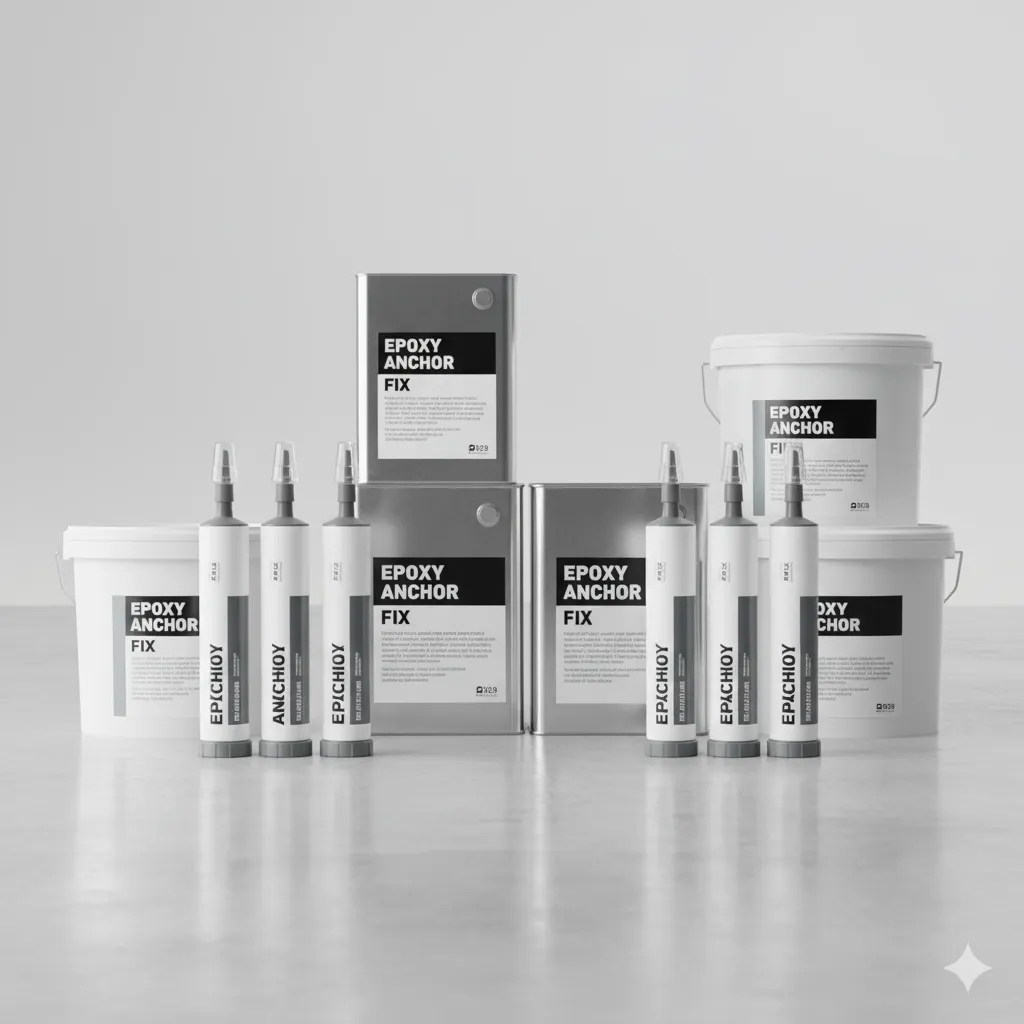
Epoxy Anchor Fix Pakistan
High-performance chemical anchoring adhesive for suitable concrete applications involving rebar, anchor bolts, threaded rods, dowels and structural fixing.
Epoxy Anchor Fix
A two-component chemical anchoring adhesive designed for approved anchoring applications in concrete and compatible substrates.
Quick Answer
What Is Epoxy Anchor Fix?
Epoxy Anchor Fix is a two-component chemical anchoring adhesive used to secure approved steel elements inside suitable concrete or masonry.
The installer drills a hole, cleans it, injects the epoxy, inserts the steel anchor and allows the adhesive to cure. Once cured, the adhesive creates a bond between the anchor
and surrounding substrate.
- Rebar anchoring
- Anchor bolt fixing
- Threaded rod installation
- Dowel anchoring
- Concrete strengthening applications
- Suitable industrial anchoring
Drill
Clean
Inject
Insert
Cure
Load
Simple Explanation
How Does Chemical Anchoring Work?
Chemical anchoring means fixing a steel anchor insidea drilled hole using an adhesive instead of relying primarily on mechanical expansion.
The epoxy fills the space around the steel anchor. After curing, it creates a bond between the steel and surrounding concrete.
The finished connection depends on the complete system, not just the adhesive.
What Affects Anchor Performance?
- Concrete strength
- Concrete condition
- Anchor diameter
- Embedment depth
- Hole diameter
- Hole cleaning
- Anchor spacing
- Edge distance
- Temperature
- Moisture
- Curing
- Applied loads
Product Benefits
Key Features of Epoxy Anchor Fix
Product performance depends on the exact formulation, technical documentation and approved application.
Strong Adhesive Bond
Creates an adhesive connection between approved steel anchors and suitable concrete when installed correctly.
Two-Component System
The resin and hardener combine during application to create the epoxy adhesive.
Controlled Injection
Injection allows the installer to place adhesive directly into the prepared drilled hole.
Rebar Anchoring
Suitable approved systems can be used for post-installed reinforcement applications.
Anchor Bolt Fixing
Suitable for approved anchor bolt installations in concrete and industrial foundations.
Threaded Rods
Chemical anchoring systems can be used with compatible threaded rods according to the installation specification.
Applications
Where Can Epoxy Anchor Fix Be Used?
Chemical anchoring can support a range of construction, repair and industrial applications when the product and design are appropriate.
Rebar Anchoring
Post-installed reinforcing bars can connect new concrete work to existing concrete in suitable structural applications.
- Concrete extensions
- Reinforcement connections
- Dowel connections
- Strengthening work
Anchor Bolt Fixing
Chemical anchoring can secure approved anchor bolts into suitable concrete for construction and industrial installations.
- Steel base plates
- Equipment foundations
- Machinery fixing
- Steel connections
Threaded Rod Installation
Compatible threaded rods can be installed with an approved chemical anchoring system.
- Correct rod diameter
- Specified embedment
- Correct hole diameter
- Proper curing
Industrial Equipment Anchoring
Chemical anchors may be suitable for machinery and equipment foundations when the complete system meets the project’s design requirements.
- Machinery
- Industrial foundations
- Equipment bases
- Vibration considerations
Concrete Repair & Strengthening
Chemical anchors can form part of a broader concrete strengthening or repair system.
- Structural modifications
- Concrete extensions
- Reinforcement connections
- Repair applications
Construction Connections
Suitable chemical anchoring systems can support approved construction connections in existing concrete.
- Steel connections
- Concrete modifications
- Structural installations
- Commercial construction
Easy Technical Guide
Technical Terms
Made Simple
Chemical anchoring uses technical terms that can be confusing for customers. Here are the most important terms in simple language.
The concrete or masonry receiving the anchor.
How far the steel anchor extends into the concrete.
The time the epoxy needs to harden and develop its required properties.
How strongly the adhesive connects the anchor to the surrounding material.
A pulling force acting on the anchor.
A sideways or sliding force acting on the anchor.
Product Data
Epoxy Anchor Fix Technical Specifications
Replace the “Refer to TDS” fields with the verified values from your actual manufacturer technical documentation.
| Property | Specification |
|---|---|
| Product Type | Two-component epoxy anchoring adhesive |
| Primary Application | Chemical anchoring |
| Typical Anchor Types | Rebar, threaded rods, anchor bolts and approved steel elements |
| Suitable Substrate | Concrete / approved substrate |
| Application Method | Injection, depending on packaging |
| Components | Two-component epoxy system |
| Color | Grey or beige, depending on formulation |
| Finish | Smooth adhesive |
| Curing Time | Refer to current manufacturer TDS |
| Application Temperature | Refer to current manufacturer TDS |
| Storage Temperature | Refer to current manufacturer TDS |
| Shelf Life | Refer to product packaging / TDS |
| Bond Strength | Refer to current manufacturer TDS |
| Compressive Strength | Refer to current manufacturer TDS |
| Tensile Performance | Refer to current manufacturer TDS |
| Packaging | Cartridge, tin or bucket |
Why don’t we publish one generic load capacity?
Anchor capacity depends on the complete system. Concrete strength, anchor diameter, embedment depth, edge distance, anchor spacing, installation quality and loading conditions can all change the final result.
For structural calculations, use the approved engineering design and product-specific technical documentation.
Installation Guide
How to Install Epoxy Anchor Fix
Follow the manufacturer’s installation instructions for the exact product and application.
Check the Design
Confirm anchor type, diameter, hole size, embedment, spacing, edge distance and required load before drilling.
Drill the Hole
Drill the hole to the diameter and depth specified by the approved installation system.
Clean the Hole
Remove drilling dust and loose material using the manufacturer’s specified cleaning procedure.
Prepare the Adhesive
Install the correct cartridge and compatible mixing nozzle. Follow the product’s dispensing instructions.
Inject the Epoxy
Inject the required adhesive into the prepared hole while following the manufacturer’s filling procedure.
Insert the Anchor
Insert the approved rebar, threaded rod, anchor bolt or dowel to the required embedment depth.
Allow Full Cure
Do not disturb or load the anchor before the required curing period has elapsed.
Inspect the Installation
For important projects, record installation conditions, product batch, embedment and inspection results.
Critical Installation Step
Why Hole Cleaning Matters
Drilling creates dust and loose particles inside the hole. These particles can interfere with adhesive contact.
Professional installers should therefore treat hole cleaning as a defined installation step rather than simply wiping the opening.
Simple Installation Logic
- Drill the specified hole
- Remove drilling dust
- Brush according to the instructions
- Remove remaining debris
- Inspect the hole
- Inject the adhesive
Curing & Temperature
Why Does Temperature Matter?
Epoxy does not cure at one universal speed. Temperature can change both working time and curing time.
An adhesive may cure differently during a hot summer installation compared with a cooler winter installation.
Always use the temperature-specific curing table supplied with the exact product.
Never Guess the Cure Time
- Check the product TDS
- Check concrete temperature
- Check ambient temperature
- Check moisture conditions
- Follow the required curing period
- Do not load early
Pakistan Conditions
Epoxy Anchoring in Pakistan’s Climate
Installation conditions can vary significantly between different regions and seasons in Pakistan.
☀ Hot Weather
- Check maximum application temperature
- Check concrete temperature
- Protect cartridges from excessive heat
- Monitor working time
❄ Cooler Weather
- Check minimum application temperature
- Follow temperature-specific curing
- Allow additional cure when required
- Do not load prematurely
💧 Damp Conditions
- Check moisture approval
- Follow wet-hole instructions
- Do not assume all epoxies are suitable
- Use the current product TDS
Pakistan Buying Guide
What Information Should You Give
Your Supplier?
01. What Are You Fixing?
Tell us whether you need the product for rebar,
anchor bolts, threaded rods, dowels, steel connections
or equipment anchoring.
02. What Is the Substrate?
Provide information about the concrete or masonry,
including whether it is new, existing, cracked, dry
or damp.
03. What Anchor Size?
Provide the actual anchor diameter, such as M12, M16,
M20 or M24.
04. What Quantity?
Provide the number of anchors, estimated adhesive
consumption or required cartridge quantity.
05. Where Is the Project?
Provide the project city and delivery location so
availability and logistics can be checked.
06. What Is the Application?
Tell us whether the project is residential, commercial,
industrial, infrastructure or structural.
Pakistan Pricing
Epoxy Anchor Fix Price in Pakistan
The price of epoxy anchor fix in Pakistan depends on the formulation, brand, packaging, quantity, project requirements and delivery location.
Instead of relying on an outdated online price, request a current quotation based on your actual project requirements.
For a Faster Quotation
- Required quantity
- Packaging preference
- Anchor type
- Anchor diameter
- Application
- Project city
- Required delivery date
Pakistan Supply
Epoxy Anchor Fix Supplier in Pakistan
Chemical anchoring solutions for contractors, builders, industrial users and construction companies.
Epoxy Anchor Adhesive
Chemical anchoring products for approved concrete anchoring applications.
Rebar Anchoring
Suitable products for approved post-installed reinforcement applications.
Anchor Bolt Fixing
Solutions for suitable anchor bolt and industrial fixing applications.
Product Formats
Available
Packaging
Cartridge
Suitable for controlled injection into prepared drilled holes.
Tube
Available for compatible project applications depending on the product formulation.
Bucket
Suitable for larger-volume applications where the manufacturer’s application method permits this format.
Confirm packaging availability, size and compatibility before ordering.
Real-World Evidence
Pakistan Project Case Study
Replace the information below with genuine project data. Do not publish invented measurements or test results.
Epoxy Anchor Fix Installation
Actual project information should be inserted here.
Steel Canopy Support Installation – Commercial Building
Gulberg III, Lahore, Punjab, Pakistan
March 2026
Threaded Rod / Anchor Bolt Fixing for Steel Canopy Supports
C30/37 Reinforced Concrete
M16 Threaded Rod
140 mm
Approximately 28°C during installation
Epoxy Anchor Fix – Batch EAF-2602-LHR (illustrative batch reference)
48 chemical anchors
Visual inspection, installation-record verification and proof-load testing of selected anchors
The installed anchors achieved the specified installation requirements, with no visible adhesive leakage, anchor movement or installation-related defects observed during inspection. Selected anchors were subjected to proof-load testing in accordance with the project engineer’s inspection procedure.
What We Learned
This illustrative Lahore installation highlights several practical factors that can influence chemical-anchor performance.
Hole Preparation Matters
The condition of the drilled hole is one of the most important installation variables. Concrete dust and loose debris should be removed thoroughly before adhesive injection.
Temperature Affects Working and Curing Time
At approximately 28°C, the installation team had to consider the product’s temperature-dependent working and curing characteristics. The adhesive should not be treated as having one fixed working time for every site condition.
Adhesive Consumption Should Be Controlled
Correct hole dimensions and consistent injection technique help control material consumption. Excessive adhesive can increase waste, while insufficient filling can compromise the intended bond between the threaded rod and concrete.
Installation Records Improve Quality Control
Recording the product batch, temperature, anchor diameter, hole dimensions, embedment depth and curing information creates a useful installation record for future inspection and maintenance.
Inspection Should Be Documented
Visual inspection alone may not be sufficient for every structural anchoring application. Where required by the project engineer or design specification, proof-load testing or other appropriate verification should be performed.
Quality Control
Chemical Anchor Installation Checklist
| Check | Record |
|---|---|
| Product | Epoxy Anchor Fix |
| Batch Number | EAF-2602-LHR |
| TDS Revision | Current manufacturer TDS applicable at installation |
| Installation Date | March 2026 |
| Anchor Type | M16 Threaded Rod |
| Anchor Diameter | 16 mm |
| Hole Diameter | As specified by the product installation data |
| Embedment Depth | 140 mm |
| Temperature | Approximately 28°C |
| Cure Time | As specified in the applicable TDS for approximately 28°C |
| Inspection Result | 48 anchors |
For Engineers
What Should Engineers Verify?
Concrete
Check concrete strength, cracking, thickness and
overall substrate condition.
Anchor
Check diameter, steel grade, embedment, spacing and
edge distance.
Loading
Consider tension, shear, combined loads and any
sustained or seismic loading requirements.
Environment
Consider temperature, moisture, chemicals,
corrosion and long-term exposure.
Product
Verify the TDS, installation procedure, approvals
and product-specific technical documentation.
Installation
Confirm drilling, cleaning, injection, insertion
and curing procedures.
Technical References
Standards & Technical Guidance
ACI CODE-355.4-24
The American Concrete Institute’s ACI CODE-355.4-24 addresses qualification requirements for post-installed adhesive anchors in concrete.
Published in 2024. Always verify the applicable edition and requirements for your project.
ICC-ES AC308
ICC-ES AC308 provides acceptance criteria relevant to post-installed adhesive anchors and reinforcing bars in concrete elements.
Product-Specific Documentation
Always verify the actual product Technical Data Sheet, Safety Data Sheet, installation instructions, evaluation reports and applicable approvals.
Important:
Do not claim ACI approval, ICC-ES approval, ETA certification, seismic approval or cracked-concrete approval unless the specific product has documentation supporting that claim.
Installation Errors
Common Epoxy Anchor Mistakes
01. Not Cleaning the Hole
02. Guessing Embedment
03. Loading Too Early
04. Wrong Product
05. Ignoring Temperature
06. Ignoring Concrete Condition
Comparison
Chemical Anchor vs Mechanical Anchor
| Feature | Epoxy Chemical Anchor | Mechanical Anchor |
|---|---|---|
| Main Fixing Method | Adhesive bond | Mechanical engagement |
| Installation | Drill, clean, inject and insert | Drill and mechanically install |
| Curing | Required | Generally not required |
| Rebar Applications | Possible for approved systems | Different application principle |
| Threaded Rods | Common application | Common application |
| Hole Preparation | Important | Important |
| Temperature | Important for curing | Depends on anchor system |
| Structural Design | Required | Required |
Key Takeaways
Epoxy Anchor Fix
Summary
The most important information to remember before purchasing or installing a chemical anchor.
Chemical anchoring uses adhesive to secure steel inside suitable concrete.
Correct hole cleaning is essential for proper adhesive contact.
Embedment depth, anchor size and concrete condition affect performance.
Temperature affects epoxy curing time.
Not every epoxy adhesive is approved for every structural application.
Structural applications require proper engineering design and product verification.
Always use the manufacturer’s current TDS, SDS and installation instructions.
For Pakistan projects, consider actual site temperature and moisture conditions.
Simple installation formula:
DRILL → CLEAN → INJECT → INSERT → CURE → LOAD
FAQ
Epoxy Anchor Fix
FAQs
Epoxy Anchor Fix is a two-component adhesive used to chemically anchor approved steel elements into suitable concrete or masonry.
It can be used for suitable applications involving rebar anchoring, anchor bolts, threaded rods, dowels, concrete strengthening and industrial anchoring.
Yes, when the specific product is qualified for the intended application and installation follows an approved engineering design.
Some chemical anchoring products are specifically qualified for post-installed reinforcing bars. Verify the exact product documentation before using it for structural rebar installation.
Yes, suitable chemical anchoring systems can be used with compatible threaded rods. Rod diameter, embedment, hole diameter and adhesive must match the approved system.
Some products allow damp or wet installation while others do not — check the exact product TDS before use.
Curing time varies by formulation and temperature — always use the manufacturer’s current curing table.
Concrete strength, concrete condition, anchor diameter, embedment depth, hole diameter, hole cleaning, edge distance, anchor spacing, temperature, moisture, curing and applied loads can all affect performance.
Contractors and construction companies can request bulk pricing by providing their required quantity, application and project location.
Price depends on the formulation, brand, packaging, quantity, project requirements and delivery location. Contact us for current pricing and bulk quotations.
Contact us for product availability, packaging, pricing and technical documentation for your construction project.
Yes. Contractors and construction companies can request bulk pricing by providing required quantity and project location.
Provide the required quantity, packaging, anchor type, anchor diameter, application, project city and required delivery date.
Need Epoxy Anchor Fix in Pakistan?
Send us your application, anchor type, quantity and project location to request current pricing, availability and product information.
- Current epoxy anchor fix price
- Bulk contractor rates
- Product availability
- Packaging options
- Technical documentation
Request a Quote
Final Summary
Epoxy Anchor Fix Pakistan –
Key Takeaways
A reliable chemical anchoring installation depends on the product, substrate, design and installation process.
Chemical anchoring uses adhesive to secure steel inside suitable concrete.
Clean the drilled hole properly before injecting epoxy.
Use the specified anchor diameter and embedment depth.
Follow the product’s temperature-specific curing schedule.
Verify the exact product’s technical approvals.
Use engineering design for structural applications.
Epoxy Anchor Fix Pakistan | Chemical Anchoring Adhesive |
Rebar Anchoring | Anchor Bolts | Threaded Rods
Technical information reviewed: August 2026.
Product-specific documentation takes precedence.

Reviews
There are no reviews yet.